

The safest nubuck care often starts with doing less. Its soft, velvety nap gives the leather its distinctive look, but a familiar household cleaner or a vigorous scrub can change its texture or colour. Effective nubuck leather sofa care protects that surface rather than treating it like smooth leather.
If you’re unsure whether your sofa is nubuck, suede or smooth leather, or what to do when a spill lands, caution makes sense. Nubuck is sanded on the grain side to create its nap, while suede has a napped surface on the underside of the hide. Using the wrong tool or too much moisture can make a mark harder to address.
This guide explains how to identify nubuck, manage everyday dust and respond promptly to spills without saturating the leather. You’ll also learn when a mark calls for professional advice rather than another home treatment. Sani-Tech Victoria provides leather cleaning in the area. Confirm that your sofa’s nubuck type and condition can be assessed before arranging service.
Key Takeaways
- Good nubuck leather sofa care starts with checking the manufacturer’s instructions before using any brush or product.
- For a spill, avoid rubbing or saturating the leather. The right response depends on the substance and the sofa’s finish.
- Use the comparison guide to understand care cautions for nubuck, suede and smooth leather without assuming they can be cleaned the same way.
- Allow the sofa to dry naturally after approved care, and avoid introducing extra moisture or heat.
- When seeking professional advice, share the care label, leather type, stain details and any previous treatments. Ask whether the proposed method suits your sofa.
How nubuck sofa care differs from smooth leather
Nubuck is leather whose grain side has been finely sanded to create a soft, raised nap, so cleaning methods need to protect that texture rather than smooth it down. Smooth leather has a more even, compact surface, while suede is generally made from the hide’s inner, flesh side. The materials can feel similar, but their structure and finish differ. For a concise background on what nubuck leather is and how it differs from suede, see this overview.
That distinction matters on a sofa. A product intended for smooth leather may leave nubuck darker, flattened or uneven in appearance. The right care depends not only on the material name, but also on the sofa’s finish, condition, manufacturer’s instructions and the specific mark. A fresh spill, an oily area and general soil may call for different responses. There isn’t one safe treatment for every surface or stain.
How can you identify nubuck on a sofa?
Nubuck often has a fine, velvety feel, and its nap may appear to shift as light or a gentle touch changes its direction. Texture alone isn’t a reliable identification test. Wear, coatings and other finishes can make materials difficult to tell apart. Check the sofa’s care label, purchase records or manufacturer guidance before cleaning. If those details aren’t available, seek professional advice about the leather type and finish rather than testing a cleaner on a visible area.
Why can smooth-leather products be unsuitable?
Creams, oils and conditioners designed for smooth leather can coat or darken nubuck, alter its nap or leave a patch that looks different from the surrounding area. Even a product labelled for leather isn’t automatically suitable for every finish. Follow instructions specific to your sofa, and don’t apply a product unless the manufacturer confirms it’s appropriate for that material.
General leather-care advice can provide useful background, but it can’t replace guidance for the exact sofa. The same caution applies to tools: don’t assume a method suitable for smooth leather or suede will work on nubuck.
If you’re uncertain, pause before treating the surface. Sani-Tech Victoria provides leather cleaning in the South Vancouver Island area, but confirm whether your particular nubuck sofa can be assessed and whether the proposed method is suitable before arranging service. That conversation can help clarify the material, its condition and the risks to consider before treatment.
How to care for a nubuck leather sofa between cleanings
Keep routine care light and controlled. The aim is to remove loose dust without flattening the nap or introducing moisture that may leave a mark. The Government of Canada’s preventive conservation guidelines offer useful background on caring for leather, but your sofa maker’s instructions should guide care for its specific finish.
What is a cautious routine for dust and everyday marks?
Before using a tool, check the care label or manufacturer’s guidance and confirm the leather type. If the instructions allow brushing, use a clean, soft brush with light strokes. Don’t assume a brush suitable for one finish is right for another.
- Regular dust: Brush gently only as directed. Don’t press hard or repeatedly work one spot.
- Everyday marks: Avoid improvised products and forceful rubbing. Follow the maker’s specific advice for the type of mark.
- Change in the surface: Stop if the nap looks flattened, the colour shifts or the leather feels different. Get material-specific advice before continuing.
What should you do when something spills?
Act calmly. Rubbing can spread a spill or disturb the surface, while adding water or cleaner may create a larger or more visible mark.
- Blot: For fresh liquid, gently press a clean, absorbent cloth onto the spill to lift what you can. Don’t rub.
- Keep it dry: Don’t saturate the leather or use heat to speed drying. Avoid household cleaners and stain-removal recipes unless the sofa maker confirms they’re suitable.
- Know when to stop: If a mark remains visible, its cause is unclear or the surface changes, pause and ask for advice suited to that leather and stain.
In short: check the care instructions, remove dust gently only if permitted, blot fresh liquid without rubbing, and stop when the stain or finish is uncertain. This cautious approach is central to nubuck leather sofa care, where an extra treatment can affect the nap as well as the mark.
For a local assessment, ask Sani-Tech Victoria about its leather cleaning service and whether your sofa’s particular nubuck finish and condition can be assessed before a method is proposed.
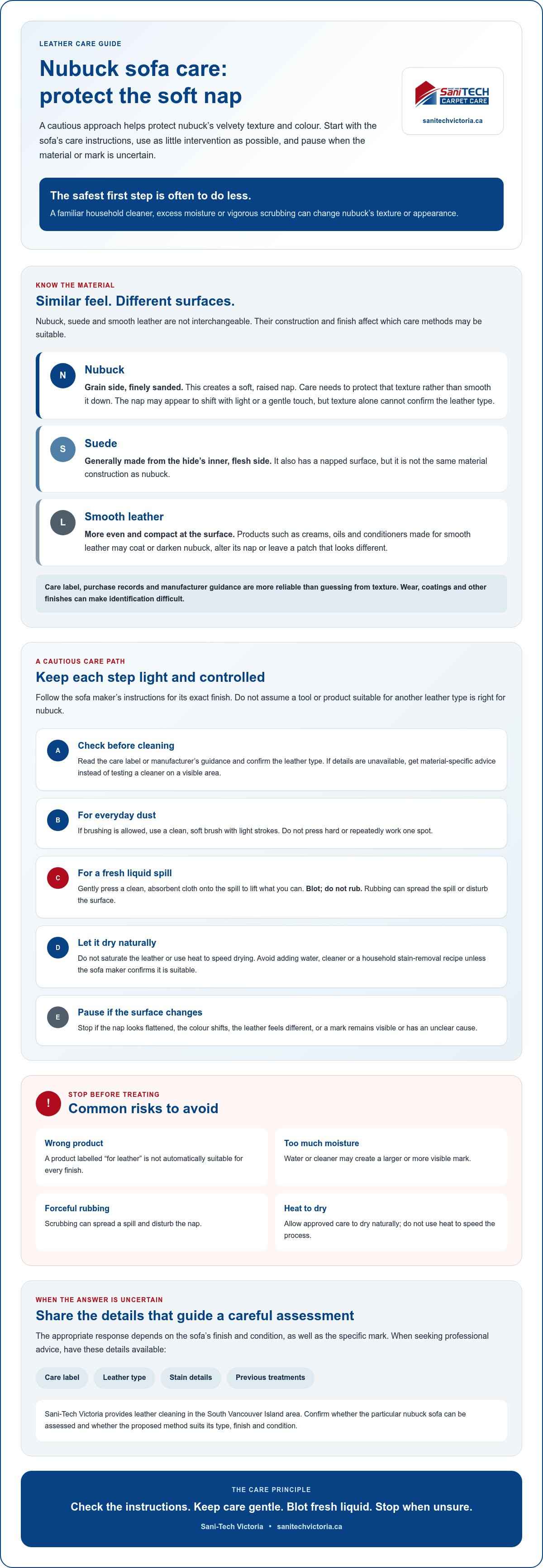
Nubuck, suede, and smooth leather: which care approach fits your sofa?
These materials can look similar at a glance, but their surfaces differ, and that can affect which care instructions apply. Nubuck has a finely abraded grain-side surface with a soft nap; suede typically has a napped surface made from the flesh side of the hide. Smooth leather has a more even surface, though coatings and finishes can change its appearance and care needs.
How does nubuck differ from suede and smooth leather?
Use the comparison as a starting point, not as a way to identify a sofa by sight alone. Furniture labels and product descriptions may use terms differently, and finishes can make visual checks inconclusive. Check the care label, product records or manufacturer’s instructions first. If the material or finish remains uncertain, seek professional identification before applying a product.
| Material | Surface | General care caution | When to seek advice |
|---|---|---|---|
| Nubuck | Fine, soft nap on the grain side of the leather | Avoid unapproved products or actions that may change the nap or colour | If the finish is unclear, a mark persists or the surface changes |
| Suede | Napped surface, generally from the flesh side of the hide | Don’t assume nubuck or smooth-leather directions apply | If the material, finish or suitable care method is uncertain |
| Smooth leather | More even surface, sometimes coated or finished | Use only care products confirmed for that sofa’s finish | If the finish is damaged, discoloured or not identified |
The sofa maker’s directions and the furniture’s current condition take priority over general material advice. Technical preservation resources, such as the National Park Service Conserve O Grams, also show why materials and treatments need to be considered carefully. They aren’t a substitute for the sofa maker’s instructions.
How should you compare home care with professional assessment?
Keep home care to limited maintenance permitted by the manufacturer. A small, fresh mark may call for a different response than a large stain, a colour change or a mark already treated with an unknown product. Don’t add another treatment if the surface is changing or the stain’s cause is unclear.
Professional upholstery methods don’t automatically suit leather upholstery. Leather needs an assessment of its type, finish, condition and cleaning risks before a method is selected. Sani-Tech Victoria provides leather cleaning, but confirm whether your specific nubuck sofa can be assessed and whether the proposed method is suitable before booking. That check is an essential part of safe nubuck leather sofa care.
How Southern Vancouver Island conditions affect nubuck sofa care
Homes in Victoria, Sidney, Sooke and Mill Bay can have different indoor conditions depending on the building, room use and season. That local variation is a reason to follow the sofa maker’s care and placement guidance, not to assume one humidity level or cleaning routine suits every home. Avoid placing the sofa where it is exposed to direct heat or strong sunlight unless the manufacturer’s instructions indicate otherwise.
After any care permitted by the manufacturer, let the sofa dry naturally in a well-ventilated room. Don’t apply heat or add moisture to speed the process. If the surface remains damp or its texture or colour changes, pause and seek advice rather than repeating the treatment. There’s no need to guess at an ideal indoor humidity level; use the maker’s instructions for your particular sofa.
What should local owners monitor at home?
Check the sofa periodically in consistent light so gradual changes are easier to notice. Look for differences in colour, nap, surface feel or the way light falls across the leather. Keep care-label information and product records accessible, and follow manufacturer guidance on room conditions and furniture placement.
- Routine observation: Note changes in texture, colour or feel, and check whether they remain stable.
- Pause and seek advice: Get an assessment if a mark spreads, colour transfers, the finish is unknown or previous treatment has altered the surface.
When should you pause home care and ask for help?
Stop before adding another product if you can’t identify the finish, don’t know what was used previously, or see spreading stains, colour transfer or surface damage. These details can help a professional consider the material and possible risks before suggesting a method. For general context, see this guide to professional upholstery cleaning guidance, while remembering that upholstery methods aren’t automatically suitable for leather.
When requesting an assessment, describe the sofa as accurately as you can, explain where the mark is and when you first noticed it, and list any products or treatments already tried. Sani-Tech Victoria provides leather cleaning, but confirm whether your specific nubuck sofa can be assessed and which method, if any, is suitable. Ask Sani-Tech about an assessment before arranging treatment.
When to ask a Victoria leather-cleaning specialist about nubuck
Consider professional advice if a stain is spreading, the colour has changed, the finish is uncertain or someone has already applied a product. These are signs that another home treatment could add risk. An assessment can help clarify what the leather is, what condition it’s in and whether a proposed cleaning method is appropriate before treatment begins.
What should you ask before booking leather cleaning?
Share what you know about the sofa and the mark so the provider can make an informed initial assessment. Have the care label or product details available, and describe any previous cleaning attempts, even if you’re unsure what was used.
- Confirm the material: Ask whether the provider can assess nubuck with a finish like yours rather than assuming all leather can be treated alike.
- Understand the proposed method: Ask how it is intended to protect the sofa’s colour and surface texture, and what risks may remain. A careful provider should be able to explain the reasoning without promising a particular result.
- Clarify preparation and aftercare: Ask what, if anything, you should do before service and how to care for the sofa afterward. Follow guidance specific to your furniture.
This helps distinguish a suitable leather-care plan from a general upholstery process. Methods used for fabric or smooth leather don’t automatically suit nubuck. Pause if the material or proposed treatment hasn’t been confirmed.
How can Sani-Tech Victoria help you choose the next step?
Sani-Tech Victoria is locally owned and operated and has served South Vancouver Island since 1983. Leather cleaning is among its services, but that doesn’t confirm every nubuck sofa can be treated. Ask whether your sofa’s particular leather and finish can be assessed, and which method, if any, is suitable. Sharing the care label, a clear description of the stain and details of past treatments can help guide that conversation.
For owners across South Vancouver Island, from Victoria to Sidney, Sooke and Mill Bay, an enquiry can be a sensible first step, not a commitment to treatment. It replaces guesswork with a discussion of the sofa’s material, condition and cleaning risks. Contact Sani-Tech Victoria to ask about an assessment and confirm nubuck suitability before booking. This careful check is a practical part of protecting your sofa through informed nubuck leather sofa care.
Protect your sofa with a careful next step
Nubuck leather sofa care starts with identifying the material and following instructions for the sofa’s exact finish. Keep routine maintenance gentle, and don’t assume products or methods made for smooth leather, suede or fabric are suitable. After a spill, blot fresh liquid without rubbing. If the mark spreads, the colour shifts or the finish is uncertain, stop and seek advice.
A professional assessment can help reduce guesswork by considering the leather type, condition, stain and any past treatments before a method is proposed. Sani-Tech Victoria is locally owned and operated and serves South Vancouver Island, with leather cleaning among its services. Confirm that your specific nubuck sofa can be assessed and that the proposed method suits its finish.
Ask Sani-Tech Victoria about leather cleaning and whether an assessment is suitable for your sofa. With careful guidance, you can make a more informed choice and protect the distinctive look of your furniture.
Frequently Asked Questions
Can I clean a nubuck leather sofa with water?
Avoid using water to clean nubuck unless the sofa maker specifically directs it. Moisture may change the leather’s colour or texture, and saturation can make a mark harder to manage. For a fresh liquid spill, gently blot with a clean, absorbent cloth without rubbing. Check the care label before taking another step. If a mark remains visible, pause and seek material-specific advice as part of careful nubuck leather sofa care.
How do I remove a fresh spill from nubuck without damaging it?
Gently blot fresh liquid with a clean, absorbent cloth, using light pressure and a clean area of the cloth as it absorbs the spill. Don’t rub, scrub or add water to the surface. Avoid heat and household cleaners, which may affect the nap or colour. If the spill leaves a visible mark, spreads or changes the surface, stop rather than trying several treatments and ask for advice suited to that leather.
Can I use a suede brush on a nubuck sofa?
Only use a suede brush if the sofa manufacturer’s care instructions allow it for your specific finish. Nubuck and suede both have a napped surface, but that doesn’t mean every tool or method is suitable for both. If brushing is permitted, work gently with a clean, soft brush and stop if the nap, colour or feel changes. If you’re unsure about the brush or finish, check with the maker first.
What should I avoid using on nubuck leather?
Avoid unapproved creams, oils, conditioners, household cleaners and stain-removal recipes. Products made for smooth leather may alter nubuck’s colour, texture or nap, and excess water can leave a visible change. Don’t scrub or apply heat to a mark. Follow the sofa maker’s instructions for its exact material and finish. If a product’s suitability isn’t clear, don’t test it on the sofa; seek material-specific guidance instead.
How can I tell whether my sofa is nubuck or smooth leather?
Nubuck often has a soft, fine nap, while smooth leather usually has a more even surface. Feel and appearance alone aren’t definitive, since finishes, wear and coatings can make identification difficult. Check the care label, purchase records or manufacturer guidance for the sofa’s material and finish. If those details don’t settle the question, ask a leather-care professional to identify it before applying a cleaner or using a brush.
Can a professional upholstery cleaner clean a nubuck leather sofa?
Possibly, but general upholstery-cleaning methods aren’t automatically suitable for leather or for every nubuck finish. Ask whether the provider can assess this type of leather, what method they propose and how they’ll consider possible changes to colour and texture. Sani-Tech Victoria lists leather cleaning as a service, but confirm whether your specific nubuck sofa can be assessed before arranging treatment.
Does Southern Vancouver Island’s coastal climate affect nubuck sofa care?
Local conditions vary between homes, so don’t assume Victoria, Sidney, Sooke or Mill Bay weather will affect every sofa in the same way. Monitor changes in the leather’s colour, texture and feel, and follow the manufacturer’s advice on placement and room conditions. Keep the room ventilated when the maker permits, and let the sofa dry naturally after approved care. Avoid relying on an unverified humidity target.