

What if carpet cleaning could fit residents’ routines, rather than asking the home to work around the cleaning crew? For retirement home carpet cleaning Victoria-wide, careful scheduling matters as much as addressing tracked-in soil and spills. Shared lounges, corridors and dining areas need attention, but access, resident comfort and drying conditions must also fit the home’s daily operations.
Managers need a clear plan that supports hygiene, protects carpet fibres and limits disruption. Southern Vancouver Island’s humid conditions make drying an important part of that plan, particularly in busy indoor spaces. The right method depends on the carpet, the level of soiling and how each area is used.
This guide explains how to coordinate professional cleaning with resident routines, prepare shared spaces, plan for drying and care for flooring over time. Sani-Tech Victoria is locally owned and operated, with commercial carpet cleaning experience dating back to 1983 and a 12-step cleaning methodology. You’ll also find practical next steps for arranging service in Victoria, Sidney, Sooke, Mill Bay and nearby communities.
Key Takeaways
- Plan cleaning in phases around resident routines, shared-space use and access needs to help limit disruption.
- Match the cleaning approach to carpet fibres and soil levels. Hot water extraction injects heated solution and immediately removes it with a vacuum.
- Consider airflow, indoor humidity and wet-weather traffic when planning for carpet drying in Victoria’s climate.
- Make retirement home carpet cleaning Victoria a planned part of facility care, with attention to hygiene, fibre preservation and daily operations.
- Sani-Tech Victoria brings local commercial carpet-care experience dating back to 1983 and a 12-step cleaning methodology to South Vancouver Island facilities.
Retirement home carpet cleaning in Victoria: what the service needs to achieve
Professional retirement-home carpet cleaning is planned care for carpeted shared and resident spaces. It addresses accumulated soil and spills while taking into account how residents, staff and visitors use each area. In an occupied home, access and daily routines need to be part of the plan from the start.
Foot traffic can grind soil into carpet fibres, especially along entrances and corridors. Spills may leave marks or residue, and repeated soiling can make busy areas look worn sooner. Professional carpet care helps manage these conditions and maintain appearance, but it isn’t a medical treatment or a replacement for the home’s infection-control practices. Hot water extraction injects heated solution into carpet and immediately extracts it with a vacuum. This is one of several carpet cleaning methods; the appropriate approach depends on the carpet and its condition.
Which retirement-home areas need a tailored cleaning plan?
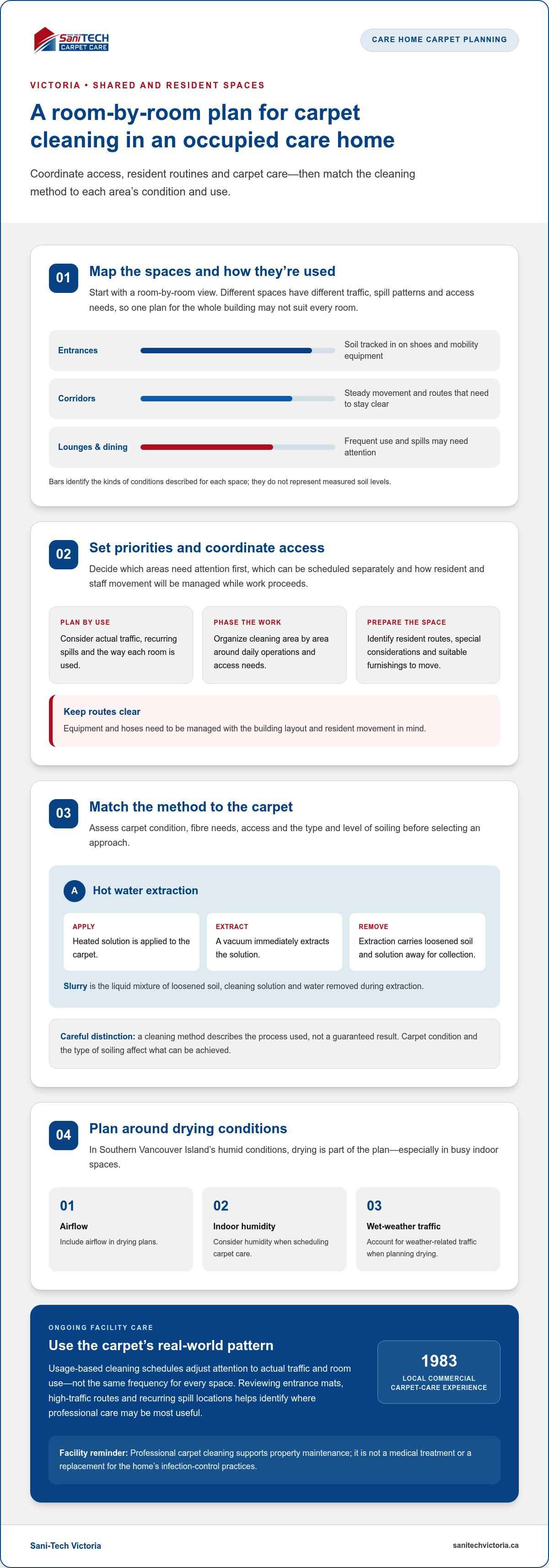
Begin with how each space is used. Entrances collect soil from shoes and mobility equipment; corridors see steady movement; lounges and dining areas may need attention for frequent use and spills. Other carpeted spaces can have different traffic patterns and access needs, so one plan for the whole building may not suit every room.
A room-by-room plan helps managers set priorities and coordinate access. Identify which areas need attention first, which can be scheduled separately and how to keep routes clear while work proceeds. Retirement home carpet cleaning Victoria facilities can plan around actual use instead of relying on a one-size-fits-all approach.
How does regular carpet care protect the facility?
Managing soil before it builds up can help carpets retain a cleaner appearance and support ongoing fibre care. Promptly assessing spills can also prevent residue from becoming part of a larger maintenance issue. The right cleaning process takes into account carpet material, visible soiling and how heavily the area is used.
Professional carpet cleaning is one part of property maintenance, alongside routine observation and care between visits. Usage-based cleaning schedules adjust attention to actual traffic and room use, rather than assigning the same frequency to every space. Reviewing entrance mats, high-traffic routes and recurring spill locations helps managers decide where professional care will be most useful.
How professional carpet cleaning works in an occupied Victoria care home
In an occupied care home, a clear sequence helps the cleaning team and facility staff coordinate access. Work starts with an assessment of the carpeted areas and their condition, followed by preparation, cleaning, extraction and a review of the results. Organizing the work area by area makes it easier to account for resident and staff movement.
For retirement home carpet cleaning Victoria facilities, the method should suit both the carpet and the site. Hot water extraction injects heated solution into carpet and immediately extracts it with a vacuum. This process helps loosen and remove soil, but results depend on factors such as carpet condition and the type of soiling. A cleaning method describes the process used, not a guaranteed result.
What happens before and during hot water extraction?
Before cleaning, the carpet’s condition, fibre needs, access requirements and treatment areas are assessed. Facility staff can identify resident routes and rooms or furnishings that need special consideration. Preparing the space may involve coordinating access, moving suitable furnishings and keeping equipment clear of busy routes. The method is selected with carpet care in mind, rather than applying the same treatment to every area.
During hot water extraction, heated solution is applied and immediately vacuumed back out. This carries loosened soil and solution away from the fibres for collection. The Carpet and Rug Institute provides commercial carpet care guidance in its CRI Commercial Carpet Standard resources. Reviewing each area as work is completed helps identify anything that may need further attention.
How do professional equipment and careful extraction support the process?
Extraction removes slurry, the liquid mixture of loosened soil, cleaning solution and water. Removing this mixture is a practical part of the cleaning process; the carpet’s condition and the amount of soiling affect what can be achieved. Access matters in a care home too, so equipment and hoses need to be managed with the building layout and resident movement in mind.
Sani-Tech Victoria maintains a dual-system equipment fleet for difficult-access properties. The equipment approach can be matched to site access and the areas being treated, recognizing that rooms may present different conditions. Coordinating which spaces are cleaned, in what order and how access is managed helps facility teams prepare and maintain daily operations.
For a planned approach tailored to your facility’s carpeted areas, discuss commercial carpet cleaning with Sani-Tech Victoria.
Resident safety and disruption: addressing concerns about carpet cleaning
Carpet cleaning in an occupied care home doesn’t have to mean closing every shared space at once. Advance coordination and phased work can help limit disruption by aligning the plan with resident routines, staff needs and room access. For retirement home carpet cleaning Victoria facilities, scheduling should account for how people will move around each work area, as well as where carpets need attention.
Carpet cleaning supports appearance and routine property care. It shouldn’t be presented as a way to prevent infection, illness or falls, or as a substitute for the facility’s infection-control procedures. OSHA is a United States agency, and its guidance on carpet decontamination discusses carpet cleaning after bodily-fluid spills. This helps distinguish carpet cleaning from broader sanitizing or disinfecting claims; it isn’t a local Canadian requirement.
How can cleaning be coordinated around residents and staff?
Map work areas against daily routines before setting the sequence. Managers and the cleaning team can agree on an order that limits simultaneous closures, then communicate temporary access changes to staff and relevant residents. Keep essential routes and room access in view throughout the work. If a corridor or lounge is being treated, identify an alternative route beforehand.
- Schedule one area at a time where practical.
- Tell staff which spaces will be temporarily unavailable and when access will change.
- Use corner guards where appropriate to protect corners from equipment or hoses.
These steps clarify expectations and help staff guide residents around active work zones.
What should managers know about drying and re-entry?
Drying conditions vary. Airflow, indoor humidity, carpet construction and site conditions all affect how quickly a treated area becomes ready for use, so don’t assume a specific drying time. Southern Vancouver Island’s humid climate is one consideration, but indoor conditions and airflow in each space matter too.
After cleaning, monitor treated areas and manage access until carpets are ready for use. Staff can maintain temporary route changes and share updates as conditions change. This supports an orderly return to the space without promising a fixed timeline or treating carpet cleaning as a substitute for other safety or hygiene measures.
Planning retirement-home carpet cleaning around Victoria’s climate and daily use
Victoria-area facilities can plan carpet care more effectively by observing how weather and daily activity affect their own spaces. Rainy conditions may bring more moisture and soil through busy entrances, though the effect varies by building, entry layout and resident routines. A brief record of visible soiling and traffic patterns helps managers adjust priorities instead of assuming every entrance or season is the same.
How do local weather and entry points affect carpet maintenance?
Note which entrances see the most movement during wet weather, where soil becomes visible, and whether tracked-in debris reaches nearby corridors or lounges. These observations help distinguish recurring high-traffic zones from rooms that need attention less often. Indoor airflow and humidity are also useful planning factors because they can affect drying after cleaning.
Keep the observations practical: record areas with visible soil, changes in entry traffic and any operational constraints affecting access. This gives managers a clearer basis for planning retirement home carpet cleaning Victoria facilities can fit to their actual conditions, rather than relying on assumptions about local weather.
How should a facility build a practical cleaning schedule?
Prioritize carpeted areas by actual use, visible soil and operational needs. An entrance with frequent traffic may need more attention than a quieter resident space, while a dining area may have different maintenance considerations. Usage-based cleaning schedules let priorities change as patterns change, without setting an unsupported fixed interval for every room.
Routine maintenance and periodic professional carpet cleaning have different roles. Regular observation helps staff notice changing conditions, while professional cleaning addresses accumulated soil through a planned process. Managers can review priorities as seasons, traffic or room use shift, then coordinate professional work around facility operations.
For guidance on maintaining commercial carpet as a property asset, see Sani-Tech Victoria’s commercial carpet cleaning guide. Carpet cleaning and disinfecting address distinct needs. Facilities planning both can learn about professional office disinfecting services separately.
To plan carpet care around your facility’s observed traffic and operating needs, request a commercial cleaning estimate from Sani-Tech Victoria.
Sani-Tech Victoria’s professional carpet cleaning for retirement homes
Retirement-home carpet care calls for a considered process, local experience and planning that respects how each facility operates. Sani-Tech Victoria is a locally owned and operated South Vancouver Island business established in 1983. Its commercial carpet cleaning experience supports facility managers planning work around carpet condition, room access and resident routines.
What experience and process can facility managers expect?
Sani-Tech Victoria follows a 12-step cleaning methodology. It provides a structured approach to professional carpet care without assuming every room, fibre or level of soiling needs the same treatment. For administrators, a defined process helps organize the work: identify areas for cleaning, consider access and operational priorities, then plan the service around the facility’s needs.
Access can be a key consideration in complex properties, particularly when equipment must move through shared spaces or into less accessible areas. Sani-Tech Victoria maintains a dual-system equipment fleet for difficult-access properties, supporting practical planning across varied building layouts. Facility teams can discuss which areas need attention and how the work can fit into the home’s operations.
For retirement home carpet cleaning Victoria-wide, facility managers can discuss the spaces involved and the day-to-day considerations that shape the service plan. Sani-Tech Victoria serves communities including Victoria, Sidney, Saanich, Mill Bay and Sooke, bringing local experience to commercial carpet care across South Vancouver Island.
How can a retirement home arrange the next step?
Administrators can prepare by noting the carpeted rooms and shared areas to be treated, access constraints and operational priorities. For example, identify high-traffic corridors, shared lounges or areas where access needs careful coordination. Sharing these details helps shape a practical discussion about the work and its sequence.
A clear plan starts with the building’s needs. Discuss the areas, access requirements and resident routines with Sani-Tech Victoria, then request an estimate for professional carpet cleaning. A well-planned service supports carpet maintenance while keeping the home’s daily operations in view.
Plan a carpet-care approach that fits your home
Retirement-home carpet care works best when it reflects how residents and staff use each space. A room-by-room plan, phased scheduling and attention to drying conditions help managers coordinate professional cleaning with daily operations. Matching the process to carpet fibres, soil levels and access needs also supports the long-term care of the flooring investment.
For retirement home carpet cleaning Victoria facilities can turn to Sani-Tech Victoria, a locally owned and operated South Vancouver Island business established in 1983. Its 12-step cleaning methodology and dual-system equipment fleet support planned work, including in difficult-access properties. More than 200 five-star customer reviews across Vancouver Island reflect the trust local customers have placed in the business.
Every facility has its own routines and priorities. Share the carpeted areas, access considerations and operational needs to start planning service with an experienced local team. Request an estimate for retirement-home carpet cleaning and take the next step towards a well-planned carpet-care programme for your home.
Frequently Asked Questions
Is professional carpet cleaning suitable for an occupied retirement home?
Yes. Professional cleaning can be planned around a facility’s routines, room use and access needs, with the approach matched to the carpet. Managers can identify which areas need attention, when rooms are available and which routes need to remain accessible. Staff communication also helps everyone prepare for temporary access changes. For retirement home carpet cleaning Victoria facilities should share their operating priorities when arranging work, rather than assume one plan fits every building.
How often should a retirement home have its carpets professionally cleaned?
There’s no single schedule that suits every retirement home. Priorities depend on traffic, carpet condition, spills and the facility’s maintenance needs. Review actual use and visible soil in entrances, corridors and lounges, then adjust attention as patterns change. Usage-based cleaning schedules offer a practical framework: busy spaces can receive priority, while quieter rooms are assessed according to their own condition instead of following the same fixed interval.
How long do carpets take to dry after hot water extraction?
Drying time varies with carpet construction, the amount of moisture extracted, airflow, indoor humidity and other site conditions. Facility managers shouldn’t rely on a standard number of hours when planning access. Monitor the treated area and coordinate temporary route changes with staff until the carpet is ready for use. Discussing the building’s conditions as part of the cleaning plan helps teams organize room access without making assumptions about drying.
Can a retirement home have carpets cleaned without moving every resident?
Cleaning can often be planned by area and sequenced around facility operations, depending on the rooms and access required. Managers can coordinate resident routines and room availability with the cleaning team, then communicate temporary changes to staff and relevant residents. This may allow work to proceed in phases instead of treating the entire home at once. Plan around the facility’s routes and needs, without assuming every room can remain in use.
What is hot water extraction carpet cleaning?
Hot water extraction is a process that injects heated solution into carpet and immediately extracts it with a vacuum. The solution helps loosen soil, and extraction removes the loosened soil, solution and water from the carpet. The method is selected with carpet condition and fibre needs in mind. It can support thorough professional cleaning, but it doesn’t guarantee removal of every stain or a specific health outcome.
Does Victoria’s damp weather affect retirement-home carpet cleaning?
Indoor humidity and airflow can influence drying, while wet-weather traffic may bring more moisture and soil through busy entrances. Conditions vary between buildings and even between rooms, so local weather alone can’t predict how a particular carpet will dry or soil. Managers can track visible changes at entry points and consider airflow and indoor humidity when planning work. This site-specific approach is more useful than relying on one assumption for every Victoria-area facility.
How can a retirement home prepare for professional carpet cleaning?
Before scheduling, identify the carpeted areas, busy routes, access needs, resident routines and operational priorities. Staff can note which rooms need careful coordination and where temporary route changes may affect movement through the home. Sharing this information with the cleaning team helps establish a workable sequence and communicate access changes clearly. A clear picture of the facility’s needs is a practical starting point for planning.