

You’ve just finished a quiet evening in your Victoria home when a splash of cooking oil or a greasy snack lands directly on your cream-coloured rug. It’s a stressful moment because grease isn’t just a surface mark; it’s a molecular glue that’s already beginning to bond with the fibres. Most homeowners worry that this mistake is permanent, or they fear that using the wrong household cleaner will only spread the mess further. Effective grease stain on carpet removal requires more than a quick scrub; it demands a precise understanding of how oils interact with modern carpet materials in our unique coastal climate.
We understand the frustration of seeing a “wicking” stain return just days after you thought it was gone. This guide shares the professional-grade techniques we’ve refined over decades to ensure complete emulsification of oily residues. You’ll master a two-phase approach that removes the spot entirely, prevents the dreaded grey shadow left by soap buildup, and restores the soft texture of your flooring. We’ll walk you through the science of breaking down stubborn oils while keeping your home environment safe and hygienic for your family.
Key Takeaways
- Understand why grease acts as a molecular glue that traps dirt and why immediate action is essential to prevent permanent fibre bonding.
- Learn the critical “blot, don’t rub” technique and how to use common household tools to lift solid grease without damaging your carpet’s pile.
- Discover the two-phase professional approach to grease stain on carpet removal using surfactants to safely break down stubborn oily residues.
- Protect your flooring from Victoria’s high humidity by managing drying times to avoid common issues like wicking or cellulosic browning.
- Identify “red flag” spills like axle grease or oil on heirloom rugs that require professional intervention to preserve your property’s value.
The Chemistry of Grease: Why These Stains Are So Stubborn
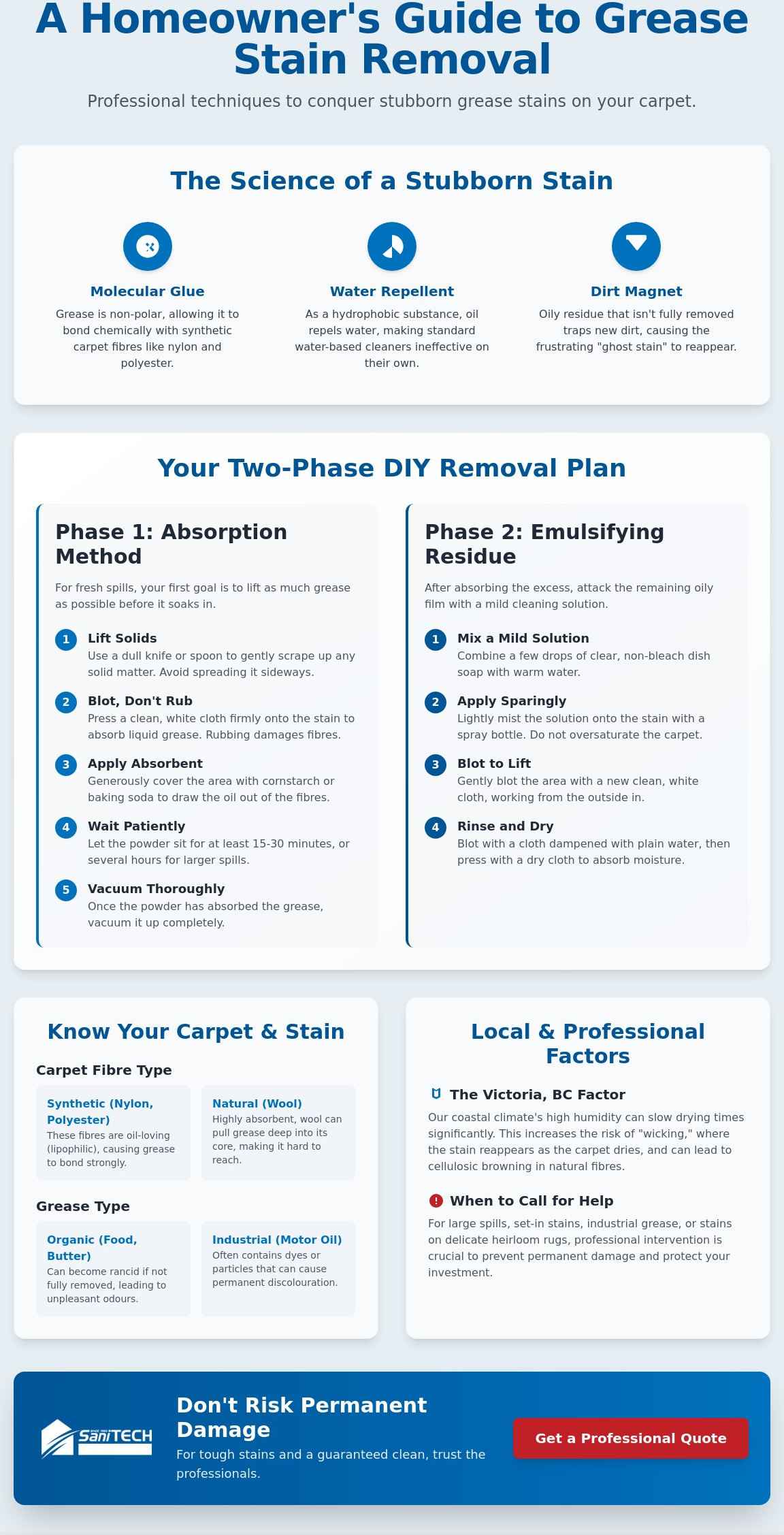
To achieve successful grease stain on carpet removal, you must first understand the molecular battle occurring within your floor’s fibres. At its core, grease is a non-polar substance. This means it is hydrophobic; it naturally repels water and resists the agitation of standard water-based household cleaners. Understanding the chemistry of grease reveals that it is often a complex mixture of oils and thickening agents that create a semi-solid barrier around carpet yarns. This barrier doesn’t just sit on the surface; it wraps around the individual filaments, creating a “sticky” site that acts as a magnet for secondary soil, pet hair, and household dust.
The type of grease matters immensely for the recovery process. Organic grease, such as butter or bacon fat found in Victoria kitchens, behaves differently than industrial lubricants like motor oil or marine grease from a local shipyard. Organic oils are prone to becoming rancid and developing odours if not fully extracted. Industrial greases often contain carbon black or metallic particles that can permanently dye the carpet fibre if you apply the wrong solvent. Heat is a double-edged sword in these scenarios. While warm water can help melt the grease to make it more mobile, excessive heat can “set” the proteins in organic spills or cause the grease to bond permanently with synthetic dyes.
Synthetic vs. Natural Fibres: The Bonding Factor
The material of your carpet dictates how deep the damage goes. Synthetic fibres like polyester and nylon are lipophilic, meaning they have a natural chemical affinity for oil. When grease hits these carpets, it doesn’t just sit on the outside; it tries to become part of the plastic itself. Natural wool fibres present a different challenge. Wool is highly absorbent and can pull grease into its porous core. Once the oil is inside the heart of a wool fibre, it becomes nearly impossible to remove without professional-grade emulsifiers that can reach deep into the yarn without stripping the wool’s natural lanolin.
The “Ghost Stain” Phenomenon
Many Victoria homeowners experience the frustration of a stain that seems to vanish, only to reappear weeks later as a dark, fuzzy patch. This is often the result of “wicking” or soapy residue. If the grease isn’t fully emulsified and extracted, the remaining oily film continues to trap new dirt. This creates a cycle where the spot looks dirty again almost immediately after a DIY cleaning. Professional carpet steam cleaning breaks this cycle by using high-temperature extraction and specialized surfactants to ensure no sticky residue remains to attract future soil.
Phase One: The Absorption Method for Fresh Grease Spills
The moments immediately following an oil spill are critical for successful grease stain on carpet removal. Your primary goal is to contain the liquid before it migrates from the surface into the backing material. We always advise Victoria homeowners to follow the “Blot, Don’t Rub” rule. Rubbing creates friction that generates heat, which can bond the grease to the fibres. Instead, use a clean white cloth to apply firm, downward pressure. If the spill has a solid component, such as a dropped piece of buttery food, use a dull knife or spoon to lift the matter straight up. Never use a side-to-side motion; this only serves to widen the affected area.
Once you have removed the excess, the science of dry absorbents becomes your greatest ally. These powders work through capillary action, literally drawing the oil out of the carpet pile and into the granules. This dry phase is essential because adding water-based cleaners too early can cause the oil to spread. Patience is the most important tool in your kit during this stage. You must allow the absorbent to sit for at least 15 to 30 minutes to ensure it has reached the deepest part of the spill. For larger cooking oil accidents, leaving the powder for several hours or even overnight provides the best results. If the spill seems overwhelming, reaching out for professional carpet steam cleaning ensures the residue is extracted before it becomes a permanent fixture in your home.
Choosing Your Absorbent: Cornstarch vs. Baking Soda
Cornstarch is often superior for fine oil particles because its smaller grain size provides more surface area for the grease to cling to. However, baking soda is a fantastic alternative for dual-action grease removal and odour neutralisation, especially for organic kitchen spills. To apply, sprinkle a generous layer over the spot and use a soft-bristled brush to gently “tamp” the powder into the fibres. You aren’t scrubbing; you’re simply ensuring the powder makes contact with every oily strand.
The Vacuuming Step: Removing the Saturated Powder
Before you reach for the vacuum, ensure the powder is completely dry and has lost its “clumpy” appearance. Saturated powder is gummy and can smear back into the carpet or clog your machine’s filters. When vacuuming delicate area rugs, use the suction-only attachment to avoid pile distortion. For wall-to-wall carpets, a standard upright vacuum is sufficient. Inspect the site after the first pass. If the powder has turned yellow or looks dark, it has reached its saturation point, and a second application of fresh powder is necessary to pull out the remaining residue.
Phase Two: Emulsifying the Remaining Oil Residue
Once the dry absorbent has been vacuumed away, you’re often left with a faint, oily shadow. This residue is the portion of the spill that has successfully bonded to the carpet fibres. To break this bond, you must introduce a surfactant. Surfactants are specialized molecules that possess a dual nature; one end is attracted to water, while the other is attracted to oil. This unique structure allows them to surround grease particles and suspend them in a water-based solution, making grease stain on carpet removal possible at a molecular level. Without this step, the oil remains “tacky,” ensuring that every bit of dust or pet dander that touches the spot will stick permanently.
Precision is vital during the liquid phase to prevent the stain from spreading. We always utilize the “Outside-In” technique. By applying your cleaning solution to the outer perimeter of the spot first and working toward the centre, you create a chemical barrier that keeps the emulsified oil contained. If you start in the middle, the liquid naturally migrates outward, carrying the grease into previously clean sections of the pile. This meticulous approach is what separates a professional-grade result from a messy DIY attempt.
The Dish Soap Method: A Canadian Homeowner’s Best Friend
Clear, grease-cutting dish soap is the safest and most effective solvent for most residential carpets. It’s formulated to break down heavy food oils without the harsh fumes associated with industrial degreasers. Proper dilution is the key to success. We recommend a ratio of 1/4 teaspoon of clear soap to one cup of lukewarm water. If you use too much soap, you’ll create a mountain of suds that are nearly impossible to rinse out. You’ll realize you’ve used too much moisture if the carpet backing feels spongy; at that point, you risk delamination or mould growth.
Rinsing and Neutralising the Area
Rinsing is the most overlooked step in home carpet care. Any soap left in the fibres acts as a magnet for future dirt, leading to a dark “ghost stain” within weeks. To prevent this, mist the area with a solution of one part white vinegar to four parts water. The acidity of the vinegar neutralises the alkaline soap residue and helps restore the carpet’s natural pH. For residents in Sidney or Sooke, where municipal water can have higher mineral content, we strongly suggest using distilled water for this final rinse. This prevents mineral deposits from making the fibres feel stiff or crunchy once dry. Finish by using the “weight and wait” technique: place a stack of clean white towels over the damp spot and weigh them down with a heavy object for several hours to draw out every last drop of moisture.
Managing Moisture: The Victoria BC Environmental Factor
Victoria’s coastal climate presents a unique challenge for grease stain on carpet removal. Our South-Vancouver Island humidity often exceeds 70% during the rainy winter months, which significantly slows down the evaporation process. When a carpet remains damp for too long, you risk a phenomenon known as cellulosic browning. This occurs when the jute backing of the carpet releases tannins that travel to the surface, leaving behind a permanent brown discolouration. To prevent this, you must prioritize high-volume airflow over simple heat. While a space heater might seem helpful, it often just creates a humid “sauna” effect that traps moisture in the pile.
Effective drying in our region requires a strategic approach. During the winter, keep your home’s ambient temperature consistent and use a dehumidifier if one is available. Directing a standard pedestal fan toward the treated spot can help, but it rarely reaches the deep backing where moisture lingers. You must achieve “bone-dry” status within 24 hours to ensure no mould or mildew develops in the damp padding. For those facing significant spills that require deep extraction, our carpet steam cleaning services utilize specialized equipment designed for the specific atmospheric conditions of the Capital Regional District.
Preventing Wicking in Humid Climates
Wicking is the primary reason grease stains seem to reappear after a DIY cleaning. As the top of the carpet dries, the moisture at the bottom moves upward to replace it through capillary action. If any oil remains in the backing, it travels up the fibre and settles on the tips, creating a fresh dark spot. You can combat this using the “sandwich” method. Place a thick layer of white paper towels over the damp area and weigh them down with a heavy book. The paper towels act as a secondary absorbent, trapping the rising oils before they can settle on the surface of the pile.
The Sani-Tech Advantage: Industrial Drying Power
Professional restoration requires more than just a household fan. We utilize industrial-grade axial air movers that create a high-velocity “laminar” flow across the floor. This specific type of airflow breaks the boundary layer of moisture, accelerating evaporation tenfold compared to domestic tools. Our high-heat steam extraction process also ensures that the water we use is hot enough to evaporate rapidly, leaving your home hygienic and mould-free. By choosing a meticulous local expert, you ensure that your property maintenance is handled with the clinical precision necessary for a worry-free experience.
When to Call the Professionals: Protecting Your Investment
While the initial steps for grease stain on carpet removal can mitigate immediate damage, certain scenarios present risks that only a restoration specialist should handle. “Red Flag” stains like industrial axle grease, permanent ink, or massive cooking oil spills involve chemical densities that easily overwhelm household tools. Attempting to scrub these out often pushes the contaminant into the subflooring or padding, leading to a permanent odour and structural damage to the carpet backing. Sani-Tech Victoria brings a 40-year legacy of meticulous stain removal to every project, providing the clinical precision required to save your flooring investment. Most major carpet manufacturers actually mandate professional steam cleaning every 12 to 18 months to maintain the validity of your warranty.
Choosing a professional service isn’t just about removing a spot; it’s about the long-term health and longevity of your home environment. DIY attempts frequently leave behind chemical residues that strip the protective coatings applied during manufacturing. This leaves your carpet vulnerable to future staining and accelerated wear. Our team understands the specific needs of Victoria properties, from high-traffic residential hallways to premium commercial spaces; for those interested in how these standards are maintained in large-scale facilities, you can discover That’s Cleaning. We provide a worry-free experience that prioritizes the safety of your family and the hygienic integrity of your living space. We present ourselves as a comprehensive resource, ensuring that your property maintenance is handled with total competence.
Specialty Care for Oriental and Area Rugs
High-value heirlooms require a level of care that goes far beyond standard wall-to-wall grease stain on carpet removal techniques. Natural fibres like silk and wool are sensitive to the high-pH levels found in many “all-purpose” cleaners. Using the wrong solution can cause irreversible colour bleeding or permanent damage to the delicate fringe. We strongly recommend our oriental rug repair victoria service for any stained heirloom rug. Our dedicated off-site cleaning facility allows us to submerge and rinse rugs in a controlled environment, ensuring total soil extraction without the risks associated with in-home cleaning.
Total Home Surface Maintenance
Grease is rarely an isolated problem. It’s often tracked from the kitchen into the living room, settling onto sofas and into the grout lines of your tile flooring. This creates a sticky film that traps bacteria and compromises your indoor air quality. By integrating a professional upholstery cleaning victoria bc into your maintenance schedule, you ensure a comprehensive level of hygiene throughout your home. Our meticulous approach restores the texture of your fabrics and the brilliance of your tiles, projecting an image of total competence and care for your property. A professional deep clean is the most effective way to alleviate the stress of maintenance and restore your home to its premium condition.
Ensure a Flawless Finish for Your Victoria Home
Successfully managing an oil spill requires moving beyond surface-level scrubbing to address the molecular bond between grease and fibre. By following a meticulous two-phase process of absorption and precision emulsification, you can prevent permanent damage and the frustrating return of “wicking” stains. It’s essential to remember that Victoria’s unique coastal humidity demands careful moisture management to avoid browning and mould in our damp climate. While DIY efforts can mitigate an immediate mess, professional grease stain on carpet removal remains the gold standard for protecting your flooring investment and maintaining a hygienic environment.
Sani-Tech Victoria has provided exceptional service to Victoria, Sidney, and Sooke since 1983. As a locally owned and operated independent business, we take pride in our reputation as meticulous local experts, especially in the specialized field of delicate oriental rug restoration. We provide a comprehensive resource for homeowners who value clinical precision and a premium, worry-free experience. Get a Free Quote for Professional Carpet Cleaning in Victoria today to restore the hygiene and beauty of your living space. Your home deserves the highest tier of professional care and a pristine result that lasts.
Frequently Asked Questions
Can I use WD-40 to remove grease from my carpet?
We strongly advise against using WD-40 or similar lubricants on your home’s flooring. While these products are effective solvents for mechanical parts, they are petroleum-based and leave behind a significant oily residue that is difficult to extract from carpet fibres. This residue will eventually oxidize and cause permanent discolouration or damage to the carpet’s secondary backing. It’s always safer to use a dedicated surfactant or professional-grade emulsifier designed for textiles.
Will baking soda alone remove an old grease stain?
Baking soda is ineffective for old, set-in grease because it’s a dry absorbent designed for liquid spills. Once a stain has dried, the oil has already bonded at a molecular level with the carpet yarns. You’ll need a liquid-phase cleaner to break that bond before any extraction can occur. While baking soda can help neutralize odours, it lacks the chemical power to emulsify hardened oils that have been sitting for weeks or months.
How much does professional grease stain removal cost in Victoria?
Professional rates for grease stain on carpet removal in the Capital Regional District are generally determined by the size of the affected area and the complexity of the fibre type. Most established businesses provide estimates based on the number of rooms or the specific dimensions of an area rug. The final cost reflects the specialized equipment and high-tier emulsifiers required to ensure the spot is removed without damaging the delicate pile or leaving sticky residues behind.
What is the best cleaner for automotive grease on car carpets?
Industrial automotive grease requires a heavy-duty degreaser that contains specific surfactants to handle metallic particles and heavy lubricants. You should look for a non-toxic, citrus-based solvent that can break down the dense carbon structure of the grease without melting the synthetic fibres of your vehicle’s interior. If the grease has caused irreversible damage, Tru-Fit Carpets by Vision Auto specializes in custom-fit automotive flooring and mats to restore your vehicle’s interior. After application, it’s vital to rinse the area thoroughly with water to ensure no chemical film remains to attract new dirt from your shoes.
Is it safe to use steam cleaners on grease stains?
Steam cleaning is exceptionally safe and effective, provided it’s done using professional-grade extraction equipment. High-temperature water helps to liquefy the grease, making it much easier to pull out of the carpet. However, if you use a home steam mop without a vacuum extraction component, you’ll likely just push the melted grease deeper into the padding. Professional steam cleaning ensures the oil is removed from your home entirely rather than just redistributed.
How do I get grease out of a wool area rug without ruining it?
Wool requires a pH-neutral cleaning approach to protect the natural lanolin and prevent the fibres from becoming brittle. You should avoid high-heat or high-alkaline cleaners that can cause “felting” or colour bleeding in natural dyes. We always recommend a meticulous, low-moisture method for in-home wool care. For valuable heirlooms, an off-site professional cleaning facility provides the most controlled environment to ensure the rug is thoroughly washed and dried without risk.
Why does my grease stain keep coming back after I clean it?
This recurring issue is almost always due to “wicking” or soapy residue. If the oil isn’t fully extracted from the base of the carpet, it travels back up to the surface as the tips dry. Alternatively, if you didn’t rinse the soap out completely, that sticky film will attract new soil to the exact same spot. A professional deep clean solves this by using high-powered suction to remove all contaminants from the backing and the pile.
Are your cleaning solutions safe for pets and children in Victoria?
We prioritize the safety and well-being of every household by using advanced, non-toxic cleaning solutions. Our professional-grade products are formulated to be effective against stubborn oils while remaining completely safe for your family and pets once the process is complete. We focus on creating a hygienic environment that is free from harsh chemical odours. This commitment to safety is a core part of our identity as a community-minded, locally owned business.