
The sharp, persistent scent of ammonia is more than just a nuisance; it’s a chemical signal that your leather’s integrity is under threat. For many Victoria homeowners, a damp, humid afternoon can suddenly reactivate hidden odours, turning a relaxing living space into a source of frustration. You’ve likely tried standard vinegar sprays or store-bought wipes, only to find the smell returns while the leather begins to feel stiff or look dull. You’re right to be cautious. Using the wrong pH balance can permanently ruin the delicate hide of a premium sofa, leading to cracks that no amount of conditioner can fix.
Learning how to clean cat pee from leather couch cushions involves more than just surface wiping. It requires a professional understanding of enzymatic breakdown to neutralize uric acid crystals for good. This guide explains the precise chemistry needed to lift stains and odours while preserving the natural oils that keep your furniture supple. We will walk you through the meticulous steps of selecting restoration-grade cleaners and applying them safely. You’ll gain the confidence to restore your home’s hygiene and protect your investment without the fear of discolouration or structural damage.
Key Takeaways
- Understand why uric acid crystals are insoluble in water and how they bond to leather fibres, creating lingering odours that return during Victoria’s humid afternoons.
- Master the “Blot, Don’t Scrub” rule to prevent forcing liquid into the sofa batting before the urine can settle deep into the leather pores.
- Discover how to clean cat pee from leather couch cushions using pH-balanced chemistry that matches the specific tanning process of your furniture’s hide.
- Learn the essential steps for post-cleaning conditioning to restore natural oils and prevent the leather from cracking or peeling after treatment.
- Compare the limitations of DIY surface cleaning against the deep extraction power of professional truck-mounted systems used by seasoned restoration specialists.
The Science of Scent: Why Cat Urine Odours Linger in Leather
Understanding the chemical composition of feline waste is the first step toward a permanent restoration. In Victoria, where the coastal air remains heavy with moisture throughout the winter months, many residents find that a cleaned sofa suddenly begins to smell again as soon as the rains return. This isn’t a failure of your effort. It is a result of the complex biological breakdown of urine. The process occurs in three distinct stages. It starts with urea, which bacteria consume to produce pungent ammonia gas. Then there is urochrome, the pigment responsible for the yellow staining on your light-coloured furniture. Finally, we face uric acid, the component that bonds most aggressively to organic hide. For a deep dive into the chemical markers involved, you can explore the science of cat urine’s lingering smell and how these compounds persist in the environment.
Uric Acid: The Invisible Enemy
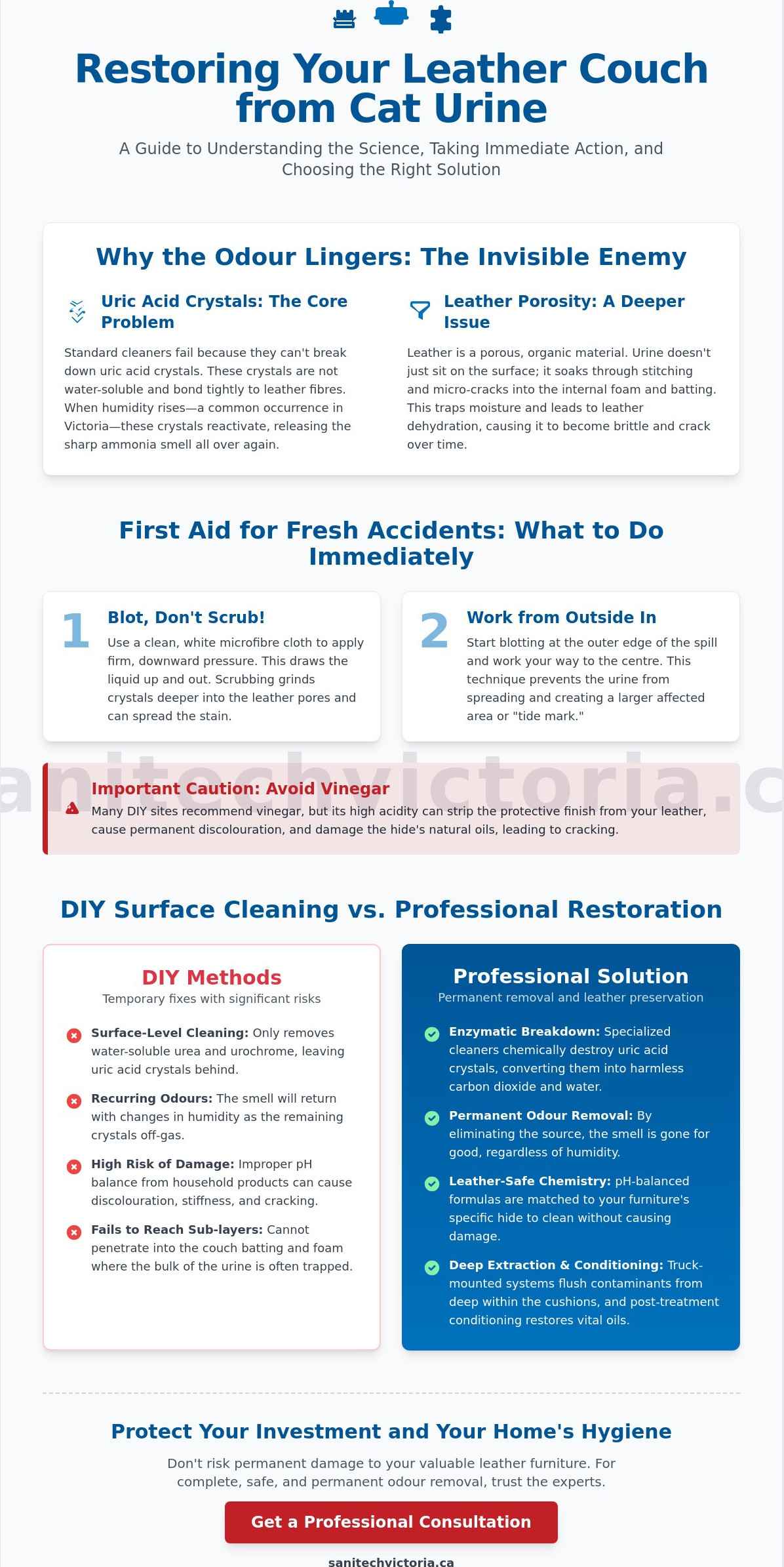
Standard household soaps and general cleaners are designed to tackle water-soluble substances. While they might wash away the urea and urochrome, they leave behind concentrated uric acid crystals. These crystals are insoluble in water and form a tight bond with the collagen fibres of the leather. When the humidity in Victoria rises, these dried salts absorb moisture from the air, causing them to off-gas and release that sharp scent once again. This cycle makes how to clean cat pee from leather couch cushions a molecular challenge rather than a simple surface chore. Only a specialized enzymatic treatment can break these crystals down into carbon dioxide and water for permanent removal. Without this chemical intervention, the odour remains dormant but present, waiting for the next damp day to resurface.
Leather Porosity and Absorption
Leather is an organic, porous material that behaves much like our own skin. High-end aniline hides are particularly susceptible to damage because they lack a heavy protective topcoat, allowing liquid to soak directly into the grain. Even on pigmented or protected leather, urine finds its way through needle holes in the stitching or microscopic cracks in the finish. Once inside, the urine reaches the internal batting and foam. Homeowners often search for how to clean cat pee from leather couch frames, but the real difficulty lies in the hidden layers of the furniture. As the liquid evaporates, it leaves behind concentrated salts. These salts create a salt trap effect, where they continuously pull moisture out of the leather hide. This leads to localized dehydration, making the expensive leather brittle and prone to cracking long after the initial accident occurred.
First Aid for Furniture: Immediate Steps for Fresh Cat Pee Accidents
Speed is the deciding factor in furniture restoration. Once liquid touches the hide, you have a narrow window before it bypasses the surface grain and enters the underlying batting. In the humid climate of Southern Vancouver Island, moisture trapped in these deep layers becomes a breeding ground for bacteria. If you are researching how to clean cat pee from leather couch furniture, the first rule is to act before the proteins begin to set. A delay of even a few hours can allow the urine to migrate from the surface into the structural foam, where it becomes significantly harder to neutralize.
The Meticulous Blotting Technique
The most common mistake homeowners make is scrubbing the spot. Scrubbing creates friction that generates heat and pushes the uric acid crystals deeper into the leather’s pores. Instead, use white, lint-free microfibre cloths to avoid any dye transfer from the fabric to your couch. Apply firm, vertical pressure to draw the liquid upward into the cloth. You can follow a step-by-step guide to cleaning cat pee from leather to ensure your hand placement maximizes absorption. Always work from the perimeter of the spill toward the centre. This prevents the liquid from spreading outward and creating a larger “tide mark” on the hide.
pH-Safe Home Remedies
Many online forums suggest using white vinegar, but this is often dangerous advice for premium leather. Vinegar is highly acidic and can strip the protective topcoat or permanently alter the colour of the hide. A safer approach involves using a mild, pH-neutral soap diluted in distilled water. After blotting the area dry, you can apply a light dusting of baking soda. It acts as a natural desiccant to pull out remaining surface moisture. Never use a hair dryer or any external heat source to speed up the process. Heat permanently “sets” the urine proteins, making the odour nearly impossible to remove without professional intervention. For those dealing with persistent smells, our stain and pet odour cleaning specialists can provide a deeper molecular treatment.
There is a clear “Point of No Return” in DIY furniture care. If you’ve blotted the area and applied a neutral cleaner but the sharp ammonia scent remains, the contamination has likely reached the interior foam. At this stage, surface wiping is no longer effective. Professional extraction becomes mandatory to save the piece. Attempting to “soak” the area with more household cleaners will only increase the volume of liquid inside the cushions, potentially leading to mould growth. Recognizing when the job exceeds home tools is the best way to protect your investment and ensure your living room remains a hygienic space for your family.
Professional Extraction vs. DIY: Why Surface Cleaning Isn’t Enough
Surface wiping is a temporary mask for a deep-seated problem. While a quick clean might remove the visible stain, it rarely addresses the liquid that has migrated into the internal foam and frame. When homeowners research how to clean cat pee from leather couch cushions, they often encounter videos suggesting handheld rental machines or home spot cleaners. These consumer units lack the industrial lift power required to pull moisture from thick upholstery cores. A professional truck-mounted system provides the high-performance suction necessary to extract contaminants at the molecular level, ensuring that no residue remains to attract future odours or soil.
Chemical precision is another area where DIY attempts often fail. Leather is not a uniform material; its reaction to cleaners depends entirely on the specific tanning process used during manufacturing. Applying a generic enzymatic spray to a vegetable-tanned hide can cause irreversible darkening or structural stiffening. Our specialists meticulously match the cleaning agent to the hide’s pH requirements, ensuring the uric acid is neutralized without stripping the leather’s essential finish. We also manage heat with extreme care. While high-temperature steam is effective for professional carpet steam cleaning in Victoria, applying that same heat directly to natural leather fibres can cause them to shrink and become brittle. A controlled, low-moisture approach is the only way to protect the furniture’s longevity.
The Limits of Consumer Rental Machines
Consumer rental machines frequently leave behind a soapy film that acts as a magnet for household dust and pet hair. More dangerously, these units often over-wet the material because they cannot extract the water they deposit. This excess moisture can lead to internal rot or “wicking,” a phenomenon where the odour and stain travel back to the surface as the piece dries. Without the vacuum pressure of professional-grade equipment, you aren’t removing the problem; you’re simply diluting it and pushing it deeper into the furniture’s structural layers.
Victoria’s Climate and Drying Challenges
The coastal humidity in Sidney, Sooke, and Mill Bay presents a unique challenge for upholstery restoration. In our damp environment, furniture that remains wet for more than 24 hours is at high risk for mildew growth and persistent musty smells. Expert techniques for removing cat urine smells and stains from leather emphasize the importance of rapid drying. Sani-Tech utilizes specialized industrial air movers to accelerate evaporation, ensuring your leather reaches its optimal moisture level quickly. This meticulous attention to the drying phase is what separates a successful restoration from a failed DIY attempt that leaves your living room smelling worse than before.
Restoring the Hide: Specialized Care for Leather and Heirloom Rugs
Ammonia is a caustic substance that does more than just create an offensive scent. It chemically alters the leather by aggressively breaking down the natural fats and oils, known as liquor, that keep the hide flexible. When you are determining how to clean cat pee from leather couch sets, you must plan for the physical restoration of these oils. Without professional re-conditioning, the area where the urine sat will eventually become brittle and develop micro-cracks. These cracks then allow future spills to penetrate even deeper, creating a cycle of damage that can eventually lead to the hide peeling or tearing. Protecting your investment requires a dual approach: total odour neutralization followed by deep-tissue nourishment of the hide.
Conditioning Leather After Odour Removal
Cleaning agents, especially those powerful enough to neutralize stubborn uric acid, inevitably strip away the essential lipids found in high-tier leather. Our restoration process involves more than just a surface wipe. We apply professional-grade conditioners that penetrate the grain to restore a supple, luxurious feel. This is a meticulous balancing act. Applying too much oil can clog the pores and attract soil, while too little leaves the furniture vulnerable to Victoria’s changing indoor humidity levels. We treat the leather as a biological material that requires specific nutrients to maintain its structural integrity and aesthetic appeal.
When the Accident Happens on an Heirloom Rug
Often, a cat’s accident isn’t limited to the sofa. If the urine reaches a hand-knotted wool or silk rug, the stakes are even higher. We strongly advise against using DIY enzyme sprays on these pieces. These store-bought solutions can cause “bleeding,” where the organic dyes from the rug run into each other, permanently ruining the intricate pattern. For these delicate items, we utilize a full submersion cleaning method. This ensures every fibre is flushed of contaminants from the face down to the backing. If the urine has already caused structural damage to the fringe or foundation, you may require specialized Oriental rug repair in Victoria to restore the piece to its original condition.
Handling delicate finishes like suede or nubuck requires even greater precision. These napped leathers cannot be traditionally washed with liquid solutions, as moisture often causes the texture to mat and harden. We utilize specialized dry-cleaning methods and fine brushes to lift stains without compromising the soft hand of the material. Throughout this process, we prioritize the health of your household by using organic and non-toxic sanitizing solutions. These products are specifically selected to be safe for pets and children while remaining lethal to bacteria and odours. If your furniture has lost its lustre following an accident, contact our leather cleaning experts to schedule a professional restoration.
Meticulous Odour Removal: The Sani-Tech Victoria Professional Standard
Sani-Tech Victoria has served as the region’s premier upholstery restoration specialist for over 40 years. Our legacy is built on a foundation of technical expertise and a deep commitment to the communities of Sidney, Sooke, and Mill Bay. We understand that a leather sofa is a significant investment for any homeowner. When you are faced with the challenge of how to clean cat pee from leather couch frames and cushions, you require a solution that goes beyond basic housekeeping. Our 12-step restoration process was developed specifically to address the unique chemical challenges of pet accidents. We don’t just mask smells; we utilize organic, eco-friendly sanitizers to neutralize odours at the molecular level, ensuring a hygienic environment for your family.
Our Advanced Extraction and Neutralization Process
The core of our methodology lies in our high-suction extraction technology. Unlike consumer machines that only treat the surface, our industrial systems reach deep into the cushion core to pull out every trace of trapped liquid. We apply specialized enzymes that are meticulously matched to your leather’s specific tanning process. This ensures the uric acid crystals are broken down without risking the integrity of the hide. Once the contaminants are removed, we perform a final pH-balanced rinse. This critical step removes any remaining cleaning agents, leaving the leather soft and ensuring no residue is left behind to irritate sensitive skin.
Long-Term Protection for Your Home
Restoration is only half of the Sani-Tech standard; we also prioritize the future longevity of your furniture. Following the deep clean, we apply professional-grade leather protectors. These create a microscopic, breathable barrier that prevents future spills from immediately soaking into the pores. This added layer of security is essential for how to clean cat pee from leather couch surfaces in the long term, as it gives you the time needed to blot away accidents before they penetrate. Given the high humidity of Greater Victoria, we also provide guidance on maintaining optimal indoor air quality to prevent the reactivation of old scents.
Our meticulous approach ensures that your furniture is returned to a like-new state, free from the sharp ammonia smells that DIY methods often leave behind. We stand behind every job with the Sani-Tech guarantee of excellence, reflecting our decades of experience as the city’s most trusted cleaning resource. Protect your investment and restore the comfort of your living space with a single phone call. Book your professional leather couch cleaning today and experience the difference that 40 years of local expertise can make.
Restore Your Living Space with Professional Precision
Maintaining a premium home environment means protecting your furniture from the corrosive effects of ammonia and dehydration. You now understand that surface wiping only addresses the visible problem. Real success lies in neutralizing uric acid crystals at the molecular level and restoring the essential oils that keep hides supple. Mastering how to clean cat pee from leather couch maintenance is the key to ensuring your investment survives for years, especially in the unique humidity of the Capital Regional District.
Sani-Tech has served South Vancouver Island since 1983. We utilize expert organic and non-toxic cleaning methods to provide specialized leather restoration and pet odour removal that prioritize your family’s well-being. Our team brings a level of clinical precision that DIY attempts simply cannot match, ensuring your furniture is both hygienic and beautiful. Restore your furniture with Victoria’s meticulous cleaning experts at Sani-Tech. Your home deserves a fresh start with a professional finish you can trust.
Frequently Asked Questions
Can dried cat urine smell ever be fully removed from a leather couch?
Yes, dried cat urine odours can be fully eliminated through professional enzymatic neutralization. While store-bought sprays often fail to reach the furniture’s core, industrial-grade extraction removes the uric acid crystals trapped within the leather fibres. Our meticulous process ensures that the scent does not return during Victoria’s humid winters. Total removal is a molecular challenge that requires specialized chemistry to break down the salts permanently.
Is it safe to use an enzyme cleaner on a leather sofa?
Specialized enzyme cleaners are safe for most leather types when applied with professional care. These solutions are essential for breaking down the chemical bonds of the urine. However, because enzymes can be drying, the hide must be treated with a pH-balanced conditioner immediately afterward to prevent cracking or loss of lustre. We always test a small, inconspicuous area first to ensure the hide’s specific tanning process reacts well.
How much does professional upholstery cleaning cost in Victoria BC?
Professional upholstery cleaning costs in Victoria vary based on the size and condition of the furniture. Rates for a standard sofa are typically lower than those for a large sectional or a complex recliner. Because leather requires specialized chemistry and conditioning, the price reflects the meticulous care needed to restore the hide. For an accurate assessment of how to clean cat pee from leather couch sets, we suggest a consultation to determine your furniture’s specific needs.
Will steam cleaning my leather couch make the cat urine smell worse?
Using high heat can make the situation worse by setting the proteins in the urine. This essentially “cooks” the odour into the leather grain, making it nearly impossible to remove later. Professional restoration avoids this by using low-moisture, pH-balanced extraction. This method neutralizes the ammonia without the risks associated with high-temperature steam cleaning, protecting both the scent and the physical integrity of the hide.
How long does it take for leather upholstery to dry after a professional cleaning?
Leather upholstery typically dries within 2 to 6 hours after a professional service. In Victoria, Sidney, and Sooke, coastal humidity can influence evaporation rates. We use high-velocity air movers to ensure a rapid finish. This prevents moisture from sitting in the seams, which is crucial for maintaining the structural integrity of the hide and preventing the growth of mildew in the underlying batting.
Does baking soda really work for old cat pee stains on leather?
Baking soda is an effective desiccant for absorbing fresh surface moisture, but it cannot neutralize old, set-in stains. It lacks the chemical power to break down the uric acid crystals bonded to the leather grain. While it might temporarily mask the scent, it doesn’t solve the underlying contamination. For older accidents, professional molecular neutralization is the only reliable way to ensure the smell is gone for good.
Why does my cat keep peeing on the same spot on the furniture?
Cats are drawn back to the same spot because their sensitive noses can detect microscopic pheromones and uric acid markers that humans cannot. If the area isn’t professionally neutralized, the cat perceives the furniture as an established territory or litter box. Total extraction is required to break this behavioural cycle. Removing these chemical markers is the most effective way to protect your furniture from repeat incidents.
What is the best way to clean cat urine from an Oriental rug?
The most effective method for cleaning cat urine from an Oriental rug is full-immersion washing. This process flushes contaminants from both the face fibres and the foundation of the rug. DIY sprays should be avoided on hand-knotted wool or silk, as they frequently cause permanent colour bleeding. A professional wash ensures that the rug is sanitized throughout without compromising the delicate organic dyes or the value of the heirloom.