

What if the fraying edges of your grandmother’s Persian rug are actually a warning sign that the entire foundation is at risk? Many homeowners view the fringe as a mere decorative border, but these threads are actually the exposed ends of the rug’s warp; they are the very skeleton that holds the piece together. If you are searching for how to repair oriental rug fringe, you likely already feel the frustration of watching a vacuum cleaner snag a loose thread or seeing the pile slowly retreat from the edges. It is a stressful situation, especially when you fear that a simple repair might devalue a cherished heirloom.
We understand that your rugs are more than just floor coverings; they are investments and family stories. This guide will help you identify the difference between basic aesthetic maintenance and the complex structural work required for an authentic restoration. You will learn when a DIY kit is a safe choice and when the meticulous skill of a professional is necessary to stop the unravelling. We will provide a clear path to restore the aesthetic beauty of your fringe and ensure your rug remains a centrepiece in your home for another 30 years.
Key Takeaways
- Recognize that fringe is the exposed end of the internal warp threads and is vital for securing the rug’s structural integrity.
- Identify specific local wear patterns, including how coastal humidity in the Victoria region can lead to the silent degradation of cotton foundations.
- Master basic maintenance techniques for minor fraying on low-value rugs, providing a clear guide on how to repair oriental rug fringe when only simple stabilization is needed.
- Explore advanced restoration methods like re-fringing and overcasting that professional specialists use to lock knots permanently in place.
- Evaluate your heirloom’s market and sentimental value to identify the “Point of No Return” before fringe damage begins to consume the actual pile.
The Anatomy of a Rug: Why Fringe Is Crucial to Structural Integrity
To the untrained eye, the fringe on an heirloom rug looks like a decorative tassel. It is easy to assume these white or cream-coloured strings are purely aesthetic additions. However, for a hand-knotted piece, the fringe is the most critical part of its physical foundation. Understanding the Anatomy of an Oriental Rug is the first step in realizing why a damaged edge is a structural emergency rather than a cosmetic flaw. When the fringe fails, the entire rug begins to fail with it.
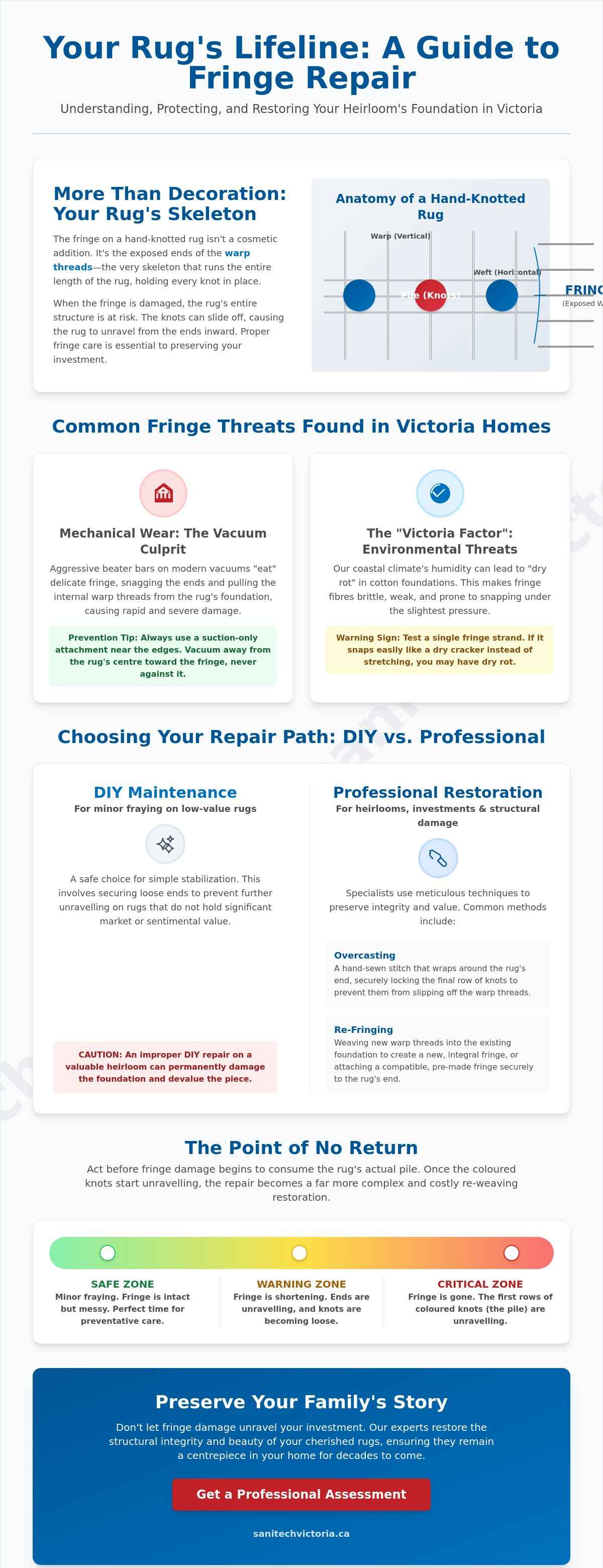
When you seek information on how to repair oriental rug fringe, you are essentially asking how to save the rug’s skeleton. Every hand-woven rug begins on a loom with vertical strings called warp threads. These threads run the entire length of the piece, from one end to the other. The wool or silk knots that create the beautiful patterns are tied directly onto these vertical warps. If the fringe, which is simply the exposed end of these warp threads, becomes damaged or worn away, there is nothing left to hold those knots in place. Without a secure end, the knots begin to slide off the foundation. This causes the rug to literally unweave from the outside in.
Warp, Weft, and the Foundation
Think of the warp threads as the vertical skeleton of your rug. They provide the tension and strength required to support thousands of hand-tied knots. Horizontal threads, known as the weft, are woven between the warps to pack the knots tightly together. Integral fringe is the structural termination of the rug foundation. It is not a separate piece of fabric; it is the very same thread that exists deep inside the pile. Because these threads are continuous, any tension or breakage at the fringe travels directly into the core of the rug. If the fringe is ignored, the damage will eventually reach the pile, leading to a much more expensive restoration process.
Why “Decorative” Fringe Is a Misnomer
There is a vast difference between a hand-knotted masterpiece and a machine-made carpet. On a machine-made rug, the fringe is often “applied,” meaning it was sewn or glued onto the finished product. While losing an applied fringe looks messy, it doesn’t threaten the rug’s existence. For an authentic Oriental rug, the fringe is a mechanical necessity. It acts as the anchor for the entire weaving process. If you lose even a single inch of this integral fringe, the structural integrity of the piece is compromised. This is why learning how to repair oriental rug fringe properly is so vital; a botched DIY job can lead to the permanent loss of the rug’s original pile. Our meticulous approach focuses on preserving these foundation threads to ensure your investment remains intact for decades.
Assessing the Damage: Common Fringe Issues Found in Victoria Homes
Living in Victoria, we enjoy a beautiful coastal climate, but our heirloom rugs often pay a silent price for that salty, humid air. Before you investigate how to repair oriental rug fringe, you must first identify the specific type of damage your piece has sustained. While some issues are universal, others are uniquely exacerbated by our local environment and household habits. Identifying the root cause is the only way to ensure a repair lasts another generation.
Mechanical Wear: The Vacuum Cleaner Culprit
The most common cause of fringe failure isn’t time; it’s the modern vacuum cleaner. Most upright vacuums feature aggressive beater bars designed to agitate synthetic carpet fibres. Unfortunately, these spinning brushes “eat” the delicate fringe, snagging the loose ends and yanking the internal warp threads right out of the rug’s foundation. This mechanical stress is the primary reason homeowners eventually search for how to repair oriental rug fringe. To prevent further fraying, always use suction-only attachments near the edges and move the vacuum head away from the centre of the rug toward the fringe. For more comprehensive care tips, our guide on rug cleaning Victoria BC offers a deep dive into preserving your textile investments.
Biological and Environmental Threats
The “Victoria factor” refers to the specific risk of dry rot in our coastal region. This occurs when the cotton foundation of a rug remains slightly damp for extended periods, a common issue in older Victoria basements or sunrooms. You can spot dry rot if the fringe snaps easily like a dry cracker when you give it a gentle tug. If the foundation has become brittle, a simple DIY fix won’t suffice; the entire end of the rug may require structural reinforcement to prevent the pile from falling away.
Other threats are more predatory. Clothes moths prefer undisturbed, dark areas, and they often begin their feast at the very edge of a rug where the fringe meets the pile. Look for “grazing” marks where the wool has been thinned or small, rice-like casings hidden among the threads. Pet damage from curious puppies or scratching cats also creates localized fringe loss that requires specialized reconstruction. Adhering to Professional Restoration Techniques is essential when biological damage or rot has compromised the organic fibres. If you notice these warning signs, seeking an expert opinion on Oriental rug repairs can prevent minor fraying from turning into a total loss of the rug’s border.
DIY Rug Fringe Repair: Techniques for Minor Maintenance
If you are considering how to repair oriental rug fringe at home, you must first determine if the rug is an heirloom or a modern, machine-made piece. DIY methods are strictly for minor maintenance on rugs with low sentimental or market value. For a true hand-knotted piece, amateur attempts often cause irreversible damage. If you decide to proceed with a minor tidying of a basic area rug, you will need professional-grade tools to avoid further fraying. A standard sewing needle is insufficient. You require a sturdy tapestry needle, high-quality mercerized cotton thread, and heavy-duty shears that can produce a clean, sharp cut. These tools ensure that you don’t snag the existing foundation fibres while you work.
One of the most dangerous mistakes homeowners make is reaching for the glue bottle. Never use glue or iron-on adhesive tape on your rug edges. While these products are marketed as quick fixes, they are the fastest way to ruin a textile investment. Adhesives become brittle over time and bond permanently with the foundation threads. This makes future professional restoration nearly impossible. Furthermore, adhesives attract dirt and oils, leaving a dark, sticky residue that degrades the natural fibres. A meticulous approach involves needle and thread, never chemicals or heat.
The Zenegra Stitch: A Temporary Fix
The Zenegra stitch is a fundamental technique used to lock the last row of knots in place. It acts as a temporary barrier to stop the unravelling process we discussed in the structural anatomy section. By loop-stitching across the entire width of the fringe, you create a tension-based lock that prevents knots from sliding off the warp threads. It is vital to remember that this method does not replace missing fringe. It merely stabilizes the existing threads to buy you time before a professional can rebuild the edge. This is a stabilization technique, not a full restoration.
Trimming and Grooming
Grooming your rug requires a steady hand and extreme caution. If you have uneven or ragged threads, you can trim them slightly to restore a neat appearance. However, you must never cut into the structural margin near the pile. Over-trimming can expose the knots and trigger the unweaving process. Additionally, avoid the temptation to use household bleach to whiten dirty fringe. Bleach is an aggressive oxidizer that destroys the protein structure of wool and the cellulose in cotton. It causes the fringe to become brittle and eventually disintegrate into dust. For deep cleaning, professional immersion is the only safe solution to restore colour without compromising strength.
Professional Restoration Techniques: How Experts Rebuild Fringes
Professional restoration is a meticulous surgical procedure for your textiles. While DIY attempts focus on temporary stabilization, experts aim for total reconstruction of the rug’s foundation. Understanding how to repair oriental rug fringe at a professional level involves hand-weaving new warp threads directly into the existing body of the rug. This is the only reliable way to ensure the repair is structural rather than just cosmetic. Our specialists meticulously match the thread material; whether it is hand-spun wool, fine silk, or mercerized cotton; to the original ply and dye lot of your piece. This attention to detail ensures the restoration is virtually invisible to the naked eye.
One of the most effective structural repairs is known as overcasting. This technique creates a permanent structural lock at the end of the rug, preventing the knots from ever sliding off the warp threads again. For homeowners who prefer a cleaner, more contemporary look, we often recommend a Kelim end. In this process, the fringe is removed, and the warp threads are woven back into the rug to create a flat, secure border. This modern finish eliminates the risk of vacuum damage while maintaining the rug’s historical value. If you value the longevity of your heirloom, consider our specialized Oriental rug repairs to secure its future.
The Hand-Weaving Process
The core of true restoration lies in the technician’s ability to needle new warp threads deep into the rug’s body, often several inches past the damaged area. This creates a robust “locking” mechanism. Unlike a simple stitch, these new threads become part of the internal skeleton, ensuring the new fringe won’t pull out even under heavy foot traffic. We take pride in maintaining the highest standards for oriental rug repair Victoria has to offer, treating every piece with the clinical precision it deserves.
Re-binding and Edge Reinforcement
Fringe damage rarely happens in isolation. Often, the side-binding, or selvage, has also begun to fray. Professional repair usually involves addressing both areas simultaneously to ensure the entire perimeter is secure. In rare cases where the original foundation is too brittle or dry-rotted to support re-weaving, we may suggest a “false fringe.” This involves sewing a pre-made fringe onto the reinforced edge of the rug. For a comprehensive look at how we protect the borders of your investment, see our guide on binding rug edges Victoria. This approach provides an aesthetic fix while the internal binding handles the heavy lifting of structural preservation.
Making the Choice: When to Invest in Professional Rug Repair
Deciding between a home fix and a specialist’s intervention is a high-stakes choice for any homeowner. It is not merely a question of aesthetics; it is a calculation of long-term value and structural survival. When you investigate how to repair oriental rug fringe, you must first determine if the piece is a replaceable household item or a unique work of art. A hand-knotted rug is a finite resource. Every row of knots lost to unravelling is a permanent reduction in the rug’s size and market worth. Professional repair acts as an insurance policy for your investment, providing a meticulous solution that preserves the textile’s history and functional life.
The long-term return on investment for professional restoration is significant. While a quality repair requires a financial commitment, it is often a fraction of the cost of replacing a high-end wool or silk rug with an equivalent piece. In the South-Vancouver Island area, where vintage and antique rugs are common centrepieces, maintaining the fringe is the most cost-effective way to prevent a total loss. Once the damage moves past the fringe and begins consuming the pile, the restoration complexity and price increase exponentially. We recommend that Victoria residents seek a professional assessment at the first sign of fringe thinning to avoid reaching the “Point of No Return.”
The “Two-Inch Rule” for Repair
A critical metric for rug health is the length of the remaining fringe. If you have less than two inches of fringe left, structural failure is imminent. This is the stage where the tension of the internal warp threads is no longer sufficient to hold the knots in place. When the fringe is ignored at this level, “piling loss” begins. This is a process where the rug actually gets shorter as the knots slide off the ends and are swept away during cleaning. To stop this retreat, it is essential to consult an oriental rug repair Victoria BC expert for a professional evaluation before the pile itself is compromised.
Summary Checklist: DIY or Pro?
To help simplify your decision, use the following criteria to determine if you should attempt a fix or call in the specialists:
- Choose DIY if: The rug is machine-made from synthetic materials, holds no sentimental value, and the fringe only needs a minor aesthetic tidy-up.
- Choose PRO if: The rug is hand-knotted, made of natural fibres like wool or silk, or is a cherished family heirloom.
- Choose PRO if: You notice any unravelling into the actual pile or if the foundation threads feel brittle and snap easily.
At Sani-Tech Victoria, we bring a 40-year history of excellence to every restoration project in the South-Vancouver Island area. Our reputation for reliability is built on decades of encountering every possible technical challenge. We treat your property with the clinical precision of a specialist and the pride of a local community business, ensuring your rugs remain beautiful and secure for another 30 years.
Protecting Your Textile Investment for the Next Generation
Preserving an heirloom rug starts with recognizing that the fringe is the foundation of its survival. We have detailed the structural role of warp threads and the specific environmental risks, like coastal humidity, that Victoria homeowners must manage. While you now understand how to repair oriental rug fringe for minor aesthetic maintenance, the choice for a hand-knotted piece always leans toward professional restoration to avoid permanent piling loss.
Sani-Tech Victoria has served Victoria and Sidney as a locally owned community business since 1983. We are dedicated specialists in the meticulous restoration of hand-knotted Oriental and Persian rugs. Don’t wait for the unravelling to reach your rug’s pile and devalue your investment. Trust your heirloom to Victoria’s restoration experts today.
Request a Rug Repair Assessment from Sani-Tech Victoria
Your rug is a piece of history. We look forward to helping you preserve it for decades of continued beauty and comfort.
Frequently Asked Questions
Can I use hot glue to stop my rug fringe from unravelling?
No, you should never use hot glue or any other permanent adhesive to secure your rug. Hot glue bonds aggressively to natural fibres and becomes brittle as it ages, making future professional restoration nearly impossible. If you are looking for how to repair oriental rug fringe safely, stay away from heat-based adhesives. These substances attract soil and leave a dark, sticky residue that eventually degrades the cotton foundation.
How much does it typically cost to repair Oriental rug fringe in Victoria?
The cost of fringe repair is determined by the linear footage of the rug and the complexity of the weaving required. Every heirloom piece is unique, so a standard flat rate doesn’t exist for these specialized services. Factors such as the material of the warp threads and the extent of the unravelling into the pile will influence the final estimate. It is always best to request a physical inspection to get an accurate quote.
Is it better to remove the fringe entirely or have it repaired?
For hand-knotted rugs, it is almost always better to repair the fringe or convert it to a Kelim end. Removing the fringe entirely without a structural lock like overcasting will cause the knots to fall off the foundation. If you prefer a modern aesthetic without tassels, a professional can create a secure, flat border. This preserves the rug’s value while updating its appearance for your Victoria home.
Why is my rug fringe turning yellow or brown after I cleaned it?
Yellow or brown discolouration after cleaning is usually caused by cellulosic browning. This happens when the cotton foundation of the rug remains wet for too long, causing lignin to wick to the surface. It can also occur if high-alkaline detergents were used during a DIY wash. Correcting this requires specialized acidic rinses and controlled drying environments that only a professional facility can provide.
How can I protect my rug fringe from vacuum cleaner damage?
You can protect your fringe by using the upholstery attachment on your vacuum instead of the main power head. Never allow a rotating beater bar to touch the edges of the rug. If you must use the upright vacuum, always push the head away from the centre toward the fringe. This prevents the brushes from catching and snapping the delicate warp threads that hold the rug together.
What is the difference between a real fringe and an artificial one?
A real fringe is an extension of the rug’s internal warp threads, while an artificial fringe is a separate strip sewn or glued onto the edge. If you can see the fringe threads disappearing directly into the pile, it is structural and integral. Artificial fringes are common on machine-made carpets. Knowing how to repair oriental rug fringe correctly depends entirely on whether those threads are the skeleton of the piece or just a decorative add-on.
How long does a professional rug fringe restoration usually take?
Professional restoration typically takes between two and four weeks depending on the current workshop queue and the intricacy of the hand-weaving. Rebuilding a fringe thread by thread is a slow, meticulous process that cannot be rushed. We take the time to ensure the colour match and tension are perfect. This patient approach is what ensures your rug remains a durable, beautiful centrepiece for another generation.