
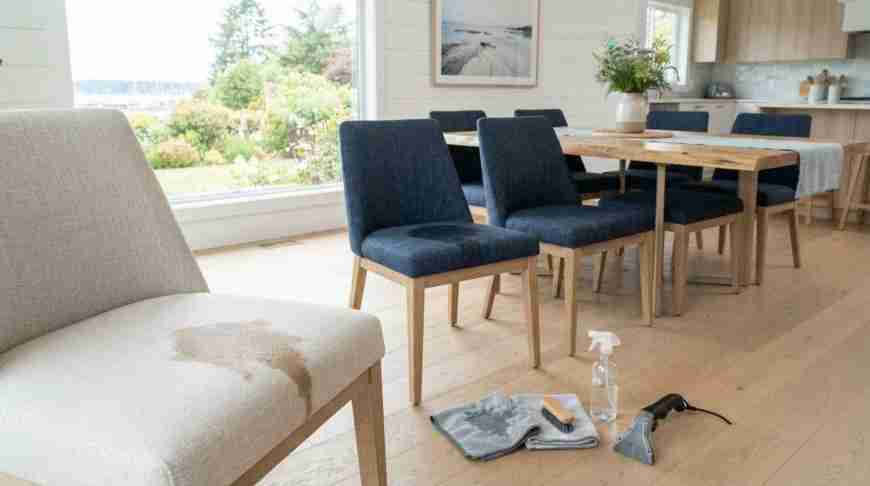
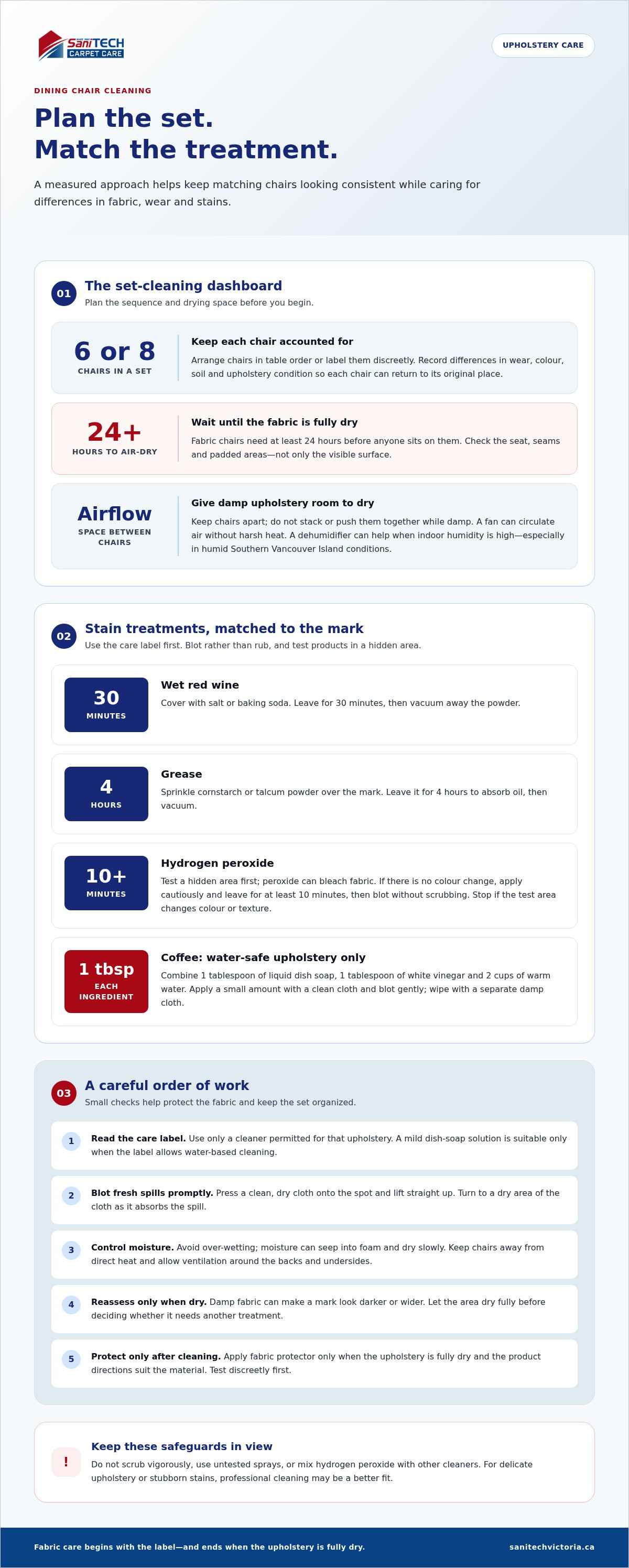
Yes, you can clean a full set of 6 or 8 dining chairs, provided you plan for complete drying. Fabric chairs need to air-dry for at least 24 hours before anyone sits on them. Successful dining chair upholstery cleaning starts with recognizing that a matching set can still include chairs with different levels of wear, soil and staining.
Dining chair upholstery cleaning matters because dining chairs see repeated use and can collect food marks, drink spills and everyday grime. A product or method that works on one chair may not suit another fabric or condition. A measured approach helps lift visible stains while caring for the material and keeping the set looking consistent.
This guide explains how to assess upholstery, choose a suitable cleaning approach and respond to fresh spills or dried marks. You’ll also learn what to consider when cleaning without a steam cleaner and how to arrange a full set for drying. Careful decisions at each stage can help maintain your chairs and show when professional care may be the better next step.
Key Takeaways
- Match your cleaning method to the upholstery care code, and test products on a hidden area before treating visible fabric.
- Use stain-specific steps for spills such as red wine, grease and coffee rather than applying one cleaner to every mark.
- Clean a full dining set in a planned sequence, keeping moisture controlled so the chairs can dry thoroughly in a ventilated room.
- For stubborn stains or delicate upholstery, professional cleaning can help address the fabric carefully and protect its condition.
Can you clean a full set of 6 or 8 dining chairs?
Yes, a full set of 6 or 8 chairs can be cleaned, but plan the work around space, fabric condition and drying. Keep a simple chair-by-chair record so you can manage the set consistently.
- Prepare a chair-by-chair plan. Label chairs discreetly or arrange them in table order before moving them. Note which seats need attention and any differences in wear, colour or upholstery condition. This record helps you return each chair to its original place and compare matching panels after they dry, instead of relying on memory.
- Organize the work area. Clear a route between the dining room and the drying space, and move smaller furniture out of the way. Set out separate cloths for cleaning and drying, plus a place for used materials. For a set of 6 or 8, working in a planned sequence reduces handling and helps keep treated chairs separate from untreated ones.
- Protect surrounding furniture and floors. Move the dining table away from the work area or cover its surface before cleaning nearby chairs. Place a protective layer under each chair to catch drips, making sure it won’t transfer colour or moisture to the floor. Keep products and cloths off the upholstery until you’re ready to use them.
- Set chairs apart as you clean them. Leave enough space between chairs for air to reach the upholstery, including the backs and undersides of the seats. Don’t stack chairs or push them together while damp. A fan can circulate air without harsh heat, and a dehumidifier can help when indoor humidity is high. Keep chairs away from direct heat.
- Check drying before returning the set to use. Feel the seat, seams and padded areas, not only the visible surface. Let fabric chairs air-dry completely for at least 24 hours before anyone sits on them. In humid Southern Vancouver Island conditions, ventilation and space around each chair matter because damp foam can dry more slowly.
- Apply fabric protection only after cleaning. Use a fabric protector only when the upholstery is fully dry and the product directions suit the material. Test it in a discreet spot first, and avoid uneven spraying or saturating the fabric. Arrange future professional cleaning according to chair use, visible soil and recurring spills. Before booking, ask how the cleaner assesses fabric, manages moisture, treats stains and plans drying.
Avoid over-wetting upholstery. Moisture can seep into foam, dry slowly and contribute to mould, mildew or musty odours. The author applies Scotch Guard once every one or two years.
Treating fresh spills and dried stains
For washable upholstery, use only a cleaner permitted by the chair’s care label. Mild dish soap may suit water-safe fabric, but test it on a hidden spot first. Blot spills promptly. Rubbing can push them deeper into the weave and roughen the surface.
- Lift residue before adding moisture. For fresh liquid, press a clean, dry cloth onto the spot, then lift it straight up. Turn to a dry area of the cloth as it absorbs the spill. For dried food, gently lift solids with a spoon. Don’t scrape sharply, as this can pull threads or spread residue across the fabric.
Remove Food, Grease, and Drink Stains
Match the treatment to the spill. For a wet red wine stain, cover it with salt or baking soda, leave it for 30 minutes, then vacuum the powder away. For grease, sprinkle cornstarch or talcum powder over the mark and leave it for 4 hours to absorb oil before vacuuming.
For coffee, combine one tablespoon of liquid dish soap, one tablespoon of white vinegar and two cups of warm water. Apply a small amount with a clean cloth and blot gently, then wipe with a separate damp cloth. Use this method only on water-safe upholstery. For tea, start by blotting and use only a cleaner allowed by the fabric label.
Use Hydrogen Peroxide for Stains
Test hydrogen peroxide on a hidden area first; it can have a bleaching effect. If the test spot shows no colour change, apply it cautiously to a heavily soiled area or stain. Leave it for at least 10 minutes, then blot the treated area without scrubbing.
Keep hydrogen peroxide in a dark bottle, because light makes it break down quickly. Don’t pour it over a chair seat or mix it with other cleaners. Stop if the test area changes colour or texture, and let the fabric dry before assessing the result.
- Choose household cleaners carefully. A mild dish-soap solution is suitable only when the care code permits water-based cleaning. Avoid abrasive powders, vigorous scrubbing and untested sprays. Even a familiar household product can affect dye or leave a ring, so limit treatment to the stain and remove residue with a clean, damp cloth.
- Reassess before repeating a treatment. After cleaning, press a dry cloth against the spot to absorb remaining moisture. Let the fabric dry fully before deciding whether the stain remains. Damp upholstery can make a mark look darker or wider. Repeating the treatment may add residue or moisture without improving the result.
Fabric-specific assessment and cleaning techniques
Choose a cleaning method based on the chair’s care label, not appearance alone. Fabric content, colour fastness and previous treatments can affect how upholstery responds to moisture and cleaners.
- Inspect the chair and locate its care label. Check beneath the seat, along the frame or on attached tags for a cleaning code. Note the fabric type and any loose seams, worn patches or colour differences before applying a product. Even a textured synthetic fabric should be cleaned according to its label, rather than assumptions about its durability.
- Follow the code’s cleaning limits. A W code permits water-based cleaners, upholstery shampoos or mild dish soap. An S code means the upholstery should be cleaned only with water-free dry-cleaning solvents. An X code calls for gentle vacuuming or light brushing only. Deep stains on X-coded upholstery require professional cleaning.
Don’t use a water-based mixture on S-coded fabric. Water may leave marks or affect the textile, while scrubbing an X-coded chair can damage its surface. If the tag is missing or unreadable, avoid wet cleaning until the fabric can be assessed.
- Test the selected cleaner discreetly. Apply a small amount to a hidden area, such as the back edge beneath the seat. Wait 10 minutes, then check for dye bleeding or fabric warping. Stop if the test area changes in colour, texture or shape. A spot test helps reveal a reaction before it affects a visible panel.
- Adjust the technique to the fabric. Use only a method allowed by the care code, even for performance fabrics designed for regular use. Their finish and fibre composition can vary, so a “performance” label doesn’t replace the manufacturer’s care instructions. For synthetic upholstery, identify the fibre and follow its label. Polyester or nylon doesn’t automatically make every cleaner suitable.
For a W-coded chair, use a small amount of approved cleaner and work gently over a limited area. Control moisture and remove residue with a clean cloth. Avoid vigorous brushing, which can alter the pile or create an uneven texture.
- Protect the fabric after cleaning. Let the upholstery dry fully before considering a fabric protector. Read the product directions for compatible materials, then test it on a hidden spot using the same 10-minute check. A protector should suit the fabric and finish; don’t apply it if the label warns against that treatment.
Cleaning upholstery without a steam cleaner
Professional cleaning starts with assessing the fabric and soil before selecting a method. DIY care can suit small marks when the care code permits it. At home, vacuum first, apply a suitable mild solution sparingly, wipe with a clean, damp cloth, then let the upholstery dry fully.
Compare Professional and DIY Cleaning
Use DIY cleaning for light surface soil or a small, recent mark when the care label allows water-based treatment. A professional can assess fabric type, condition and soiling before choosing a suitable method. That assessment matters for delicate upholstery, broad soiling, persistent odours or stains that remain after careful home treatment. In commercial dining rooms or high-traffic hospitality spaces where furnishings face constant use, dedicated facility teams like Showpiece Commercial Cleaning illustrate how professional contract cleaners maintain high-standard seating and venue presentation.
Avoid repeating DIY treatments if the fabric stays damp or the mark spreads. More moisture and scrubbing can leave residue or affect the textile’s texture.
Clean Upholstered Chairs at Home
Vacuum the seat, back and seams with an upholstery attachment before wet cleaning. In a small container, mix a teaspoon of dishwashing liquid, one teaspoon of baking soda and one teaspoon of vinegar with hot water. Don’t soak the fabric. Follow its care code and test the mixture on a hidden area before treating visible upholstery.
Work gently with a soft cloth, then wipe the area with a clean, damp cloth. Let the chair dry in a ventilated space.
- Control the amount of solution. Dampen the cloth instead of pouring the mixture onto the chair. Treat a small section at a time so you can see whether the fabric reacts or becomes too wet. Rinse the cloth as needed, and use a separate clean, damp cloth to remove leftover soap and baking soda.
- Handle pet accidents with care. On water-safe fabric, mist the affected area with equal parts warm water and white vinegar. Blot with a clean cloth, then sprinkle baking soda over the spot to absorb odours. For stronger odours, leave it overnight before vacuuming. Don’t use this method if the care label rules out water.
- Finish by drying carefully. After wiping away the solution, press a dry towel against the upholstery to lift excess moisture. Keep the chair in a well-ventilated room and use a fan to circulate air without harsh heat. Don’t sit on the chair while it feels damp, and don’t scrub the fabric to speed drying.
- Stop if the fabric changes. If a test spot shows colour transfer, texture changes or water marks, stop using that cleaner. For upholstery marked S or X, follow the label’s solvent-only or vacuum-only direction instead of applying a water-based household mixture.
Cleaning upholstered chairs in full dining sets
A set of 6 or 8 chairs needs a plan for consistent cleaning, clear airflow and drying space. Work systematically so every chair receives attention without leaving damp upholstery crowded together.
- Map the set before starting. Check each chair in good light and note visible soil, spills, odours or wear. Compare matching chairs to spot differences in colour or fabric condition. This record helps you treat the same upholstery consistently and avoid overlooking a less-used chair at the end of the table.
- Set up a clear work area. Move chairs away from the table and leave room to reach the seat backs, sides and seams. Keep the route to a ventilated drying room clear. For a full set, prepare clean cloths and set aside those that become soiled, rather than spreading residue from chair to chair.
- Work through the set in a deliberate sequence. Start at one end of the table and finish at the other, recording which chairs are clean and which still need attention. Treat matching upholstery with the same fabric-appropriate method, adjusting for visible differences in soil. Avoid rushing between chairs or applying more solution just to make every surface look uniformly wet.
- Arrange each chair for airflow. Place cleaned chairs in a well-ventilated room with enough space for air to circulate around the seats and backs. Don’t stack chairs or push them together while damp. A fan can circulate air without harsh heat, and a dehumidifier can help when indoor humidity is high.
Keep the set away from direct heat. Moisture trapped in the foam can dry slowly and contribute to mildew or musty odours.
- Allow time before returning chairs to use. Let fabric upholstery air-dry completely for at least 24 hours before anyone sits on it. Check padded areas and seams, not just the exposed surface. In Southern Vancouver Island’s damp conditions, good ventilation and controlled indoor humidity can help the set dry more evenly.
- Address lingering odours separately. Place an open container of activated charcoal or a fabric-safe odour absorber near an odorous chair for 24-48 hours. Keep it close to the affected furniture, not on the upholstery. Once the chairs are dry, compare their appearance and smell, then return them to the dining area.
Sani-Tech Victoria: Carpet Steam Cleaning
Sani-Tech Victoria cleans dining chair upholstery, including chairs with stubborn stains, extensive soil or delicate fabric that needs careful attention. Professional cleaning is a practical next step when home treatment hasn’t lifted marks or when a full set needs consistent care. The approach takes the upholstery material and its condition into account while addressing accumulated soil.
For matching dining chairs, professional upholstery care can help treat the set systematically instead of focusing only on the most visible marks. Sani-Tech Victoria also provides Carpet Steam Cleaning, Area Rug Cleaning and Leather Cleaning for related furnishings and flooring needs.
Contact Sani-Tech Victoria to discuss your dining chair upholstery.
Keep your dining space ready for what comes next
Regular attention to dining chairs helps keep the room comfortable and ready for everyday meals. Careful dining chair upholstery cleaning can also help protect fabric from avoidable wear caused by harsh scrubbing, unsuitable products or excess moisture. When updating your broader room aesthetic, bespoke window treatment specialists like Fabrico offer inspiration for coordinating custom curtains and blinds with upholstered furnishings. If the upholstery needs more than spot care, professional cleaning is a practical next step.
Sani-Tech Victoria offers Upholstery Cleaning, along with Carpet Steam Cleaning and Area Rug Cleaning. These services can help care for furnishings and floor coverings that see daily use, with the cleaning approach suited to the material and its condition.
Make a clear next move for your dining chairs. Get in touch with Sani-Tech Victoria to discuss professional upholstery care and keep your dining space ready for the occasions ahead.
Frequently Asked Questions
How can I identify the upholstery fabric and check its cleaning code?
Before dining chair upholstery cleaning, look for a care label beneath the seat, along the frame or on an attached tag. It may name the fibre or give a cleaning code: W permits water-based cleaning, S indicates water-free solvent cleaning, and X limits care to gentle vacuuming or brushing. Check every chair in a matching set, since replacement chairs may use different fabric. If the label is missing, don’t guess based on appearance alone.
How do you remove food, grease, wine, and coffee stains from chair upholstery?
Gently lift solid food with a spoon, then blot liquid rather than rubbing it into the weave. For dining chair upholstery cleaning, choose a stain treatment that suits both the care code and the spill. Don’t combine cleaners or pour products directly onto upholstery. If a stain remains after drying, repeated wet treatment can spread the mark or leave residue in the fibres.
Can you steam clean upholstered dining chairs safely?
Steam cleaning can suit some upholstery, but only when the care instructions allow water-based cleaning. Vacuum first, control the amount of moisture and avoid saturating the seat padding. Don’t steam an S-coded chair, which requires water-free solvent cleaning, or an X-coded chair, which should only be vacuumed or lightly brushed. A household garment steamer isn’t a substitute for checking fabric compatibility.
What are the risks of DIY upholstery cleaning, including shrinkage, fading, and water marks?
DIY cleaning can leave marks or alter fabric if the cleaner, moisture level or technique doesn’t suit the upholstery. Excess water may reach the foam and dry slowly, while vigorous rubbing can distort the surface. A product that affects the dye may cause colour to bleed or fade. Uneven application can also leave water marks or residue. Test in a discreet spot and stop if the fabric changes in colour, texture or shape.
How long does upholstery take to dry after cleaning, and how can you speed it up?
Allow cleaned fabric dining chairs to air-dry completely for at least 24 hours before anyone sits on them. Drying can take longer when seats are thickly padded, seams retain moisture or indoor humidity is high. Place chairs in a ventilated room with space between them, circulate air with a fan, and use a dehumidifier if needed. Avoid direct heat, which can dry fabric unevenly.
How often should dining chair upholstery be professionally cleaned?
Arrange professional cleaning according to chair use, visible soil and recurring spills.
How do you find a reputable upholstery cleaner in Canada, and what questions should you ask?
Before booking, ask how the cleaner assesses fabric, manages moisture, treats stains and plans drying. Consider professional care for delicate upholstery, broad soiling, persistent odours or stains that remain after careful home treatment.